

You pull your smartphone out of your pocket, unlock the screen, and turn it sideways to watch a video. Instantly, the image flips from portrait to landscape. It is a seamless, everyday interaction that we entirely take for granted. But how does a solid slab of glass and metal actually know which way is down? The answer lies in a microscopic mechanical miracle known as a MEMS accelerometer. This tiny component, buried deep within the silicon architecture of your device, relies on invisible weights to constantly measure the pull of gravity. It is a triumph of modern tech that bridges the gap between the physical forces of our universe and the digital interfaces we interact with daily.
The Microscopic Architecture of Motion
To understand the secret behind this phenomenon, we must first shrink our perspective down to the microscopic level. MEMS stands for Micro-Electromechanical Systems. Unlike traditional computer chips, which only move electrons through solid-state pathways, a MEMS chip contains actual, physical moving parts. However, these parts are so infinitesimally small that they are measured in micrometers—a fraction of the width of a single human hair.
Inside the accelerometer, there is a microscopic piece of silicon that acts as a “seismic mass” or a tiny weight. This weight is not bolted down rigidly; rather, it is suspended in mid-air by microscopic silicon tethers that act like highly flexible springs. When you hold your phone perfectly still, gravity pulls down on this tiny suspended weight, causing the springs to stretch ever so slightly in the direction of the Earth. When you rotate the device, the direction of gravity relative to the phone changes, and the weight shifts accordingly. These are the invisible weights that tell your pocket which way is down.
Translating Gravity into Digital Data
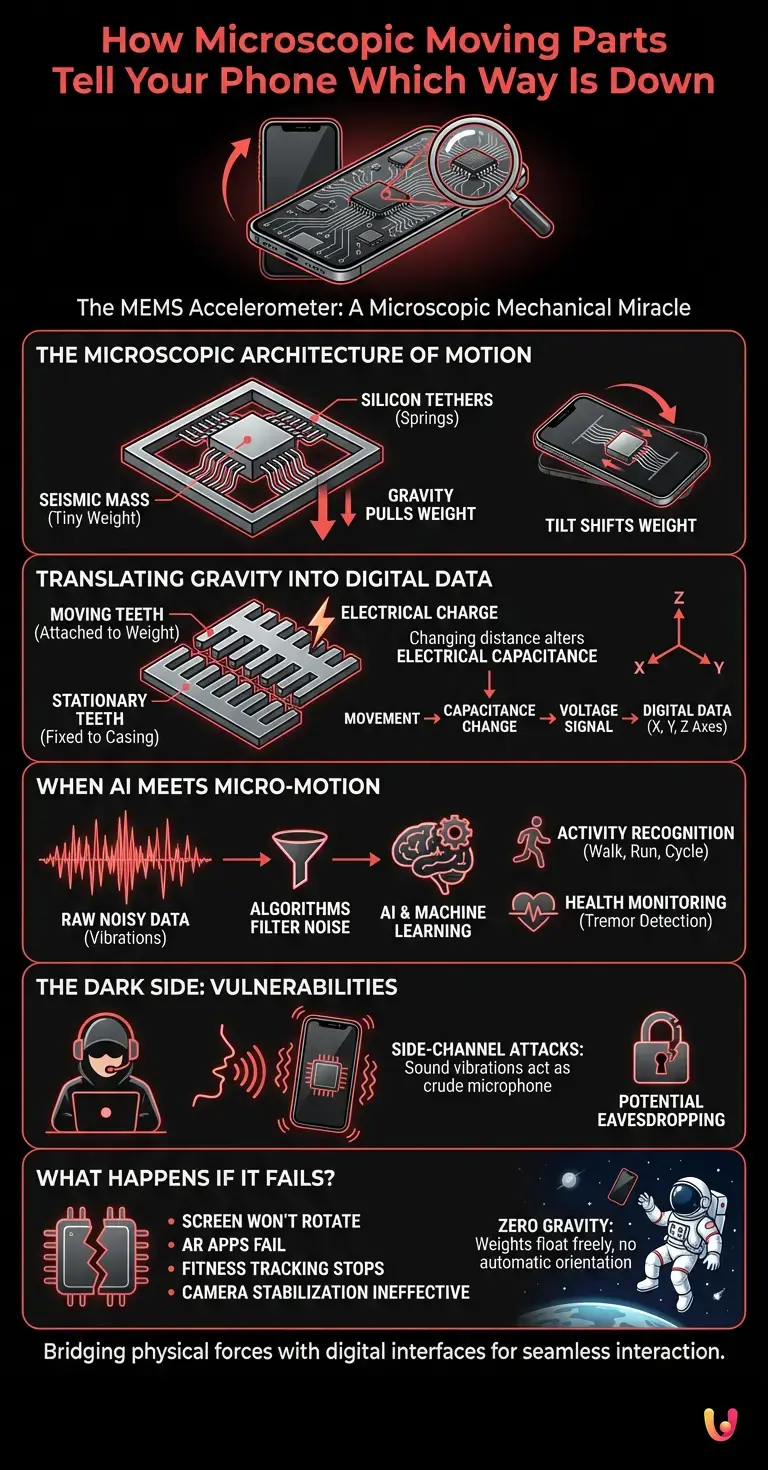
Having a microscopic weight dangling on silicon springs is a marvel of engineering, but how does the phone actually “read” this movement? The secret lies in a principle of physics called electrical capacitance.
Attached to the suspended weight are tiny microscopic protrusions that look like the teeth of a comb. Interlocking with these moving teeth is another set of stationary teeth attached to the rigid casing of the chip. They sit incredibly close to one another but never actually touch. An electrical charge is passed through these interlocking fingers, creating a specific electrical capacitance based on the distance between them.
When you tilt your phone, gravity pulls the suspended weight. As the weight moves, the moving teeth slide closer to one side of the stationary teeth and further away from the other. This microscopic shift in distance—sometimes just a few nanometers—changes the electrical capacitance. The microchip detects this minute change in voltage and translates it into digital data. Because the accelerometer contains three of these microscopic setups oriented at 90-degree angles to one another, it can measure the pull of gravity across the X, Y, and Z axes, giving the device a perfect three-dimensional understanding of its orientation.
When AI Meets Micro-Motion

The raw data generated by these invisible weights is incredibly noisy. Every time your hand shakes, every time you take a step, and every time you set the phone on a vibrating table, the microscopic springs bounce wildly. If the phone reacted to every single vibration, your screen would flip erratically, and your navigation apps would be rendered useless.
This is where software innovation steps in. Modern devices use sophisticated algorithms to filter out the “noise” of daily life and isolate the steady, constant pull of gravity. Furthermore, the integration of AI has revolutionized how this motion data is interpreted. Machine learning models are trained to recognize the specific vibrational signatures of different activities. By analyzing the microscopic bounces of the accelerometer’s weight, AI can tell if you are walking, running, cycling, or driving. Health-focused startups are even utilizing this highly sensitive data to detect the early onset of neurological conditions, such as Parkinson’s disease, by analyzing subtle tremors in a user’s hand that are imperceptible to the human eye.
The Dark Side of Motion Sensing
While the benefits of MEMS technology are vast, they also introduce unexpected vulnerabilities. In the rapidly evolving field of cybersecurity, researchers have discovered that these invisible weights can be exploited by malicious actors. Because accelerometers are essentially highly sensitive vibration detectors, they can inadvertently act as crude microphones.
In a theoretical “side-channel attack,” hackers can write malware that accesses the accelerometer data without needing the strict permissions required to access the actual microphone. When you speak near your phone, the sound waves create microscopic vibrations in the device’s chassis. The suspended weights inside the accelerometer bounce in response to these acoustic waves. Advanced algorithms can then analyze these vibrations to reconstruct the audio, potentially allowing bad actors to eavesdrop on conversations or deduce passwords based on the vibrational patterns of your fingers tapping the screen. This highlights a fascinating and terrifying reality: the more sensitive our devices become to the physical world, the more avenues open up for exploitation.
What Happens If It Fails?
Given their microscopic size and delicate moving parts, one might wonder what happens if the accelerometer breaks. In the early days of MEMS technology, dropping a device could easily snap the microscopic silicon springs, permanently blinding the device to gravity. Today, these chips are engineered with microscopic “bumpers” that prevent the seismic mass from moving too far and breaking its tethers during a high-impact drop.
However, if an accelerometer does fail due to extreme physical damage or a manufacturing defect, the user experience degrades rapidly. The most obvious symptom is the failure of the screen to rotate. But the consequences go deeper. Augmented reality (AR) applications lose their ability to anchor digital objects to the physical world. Fitness trackers stop counting steps. Even the camera’s optical image stabilization—which relies on motion data to physically shift the lens and counteract the shaking of your hands—becomes entirely ineffective, resulting in blurry photos.
Interestingly, these sensors can also be tricked by extreme environments. In the zero-gravity environment of the International Space Station, the invisible weights float freely in the center of their microscopic casings. Without the constant downward pull of Earth’s gravity, astronauts’ tablets and smartphones cannot automatically orient their screens, requiring software overrides to lock the display in a usable position.
In Brief (TL;DR)
Smartphones determine their orientation using a microscopic mechanical component called a MEMS accelerometer, which relies on tiny suspended weights to measure gravity.
As these tiny weights shift, they alter electrical capacitance, generating raw data that artificial intelligence filters to accurately track your specific physical activities.
Despite their immense utility, these highly sensitive motion sensors introduce unique cybersecurity vulnerabilities by potentially acting as microphones that secretly capture ambient sound waves.
Conclusion

The next time you casually flip your device to watch a video or check a map, take a moment to appreciate the invisible weights working tirelessly in the palm of your hand. The MEMS accelerometer represents a profound intersection of mechanical engineering, quantum-level physics, and advanced software processing. It is a testament to human ingenuity that we have managed to carve microscopic springs and weights out of solid silicon, allowing our digital devices to feel the fundamental forces of the universe. These tiny, unseen mechanisms not only tell our pockets which way is down, but they also serve as the foundational sensory organs for the ever-expanding digital world we inhabit.
Frequently Asked Questions

Your device uses a tiny component called a MEMS accelerometer to detect the pull of gravity. It contains microscopic silicon weights suspended by flexible springs that shift when you tilt the device. The phone measures these tiny movements and uses software algorithms to determine its exact orientation in three-dimensional space.
It is a micro-electromechanical system that acts as a highly sensitive motion sensor built directly into the silicon chip of your device. Unlike standard solid-state electronics, it features actual moving physical parts that measure physical forces like gravity and acceleration. These microscopic mechanisms translate physical movement into digital data that your apps and operating system can understand.
Yes, malicious actors can theoretically use highly sensitive motion sensors to eavesdrop on users through a method known as a side-channel attack. Because sound waves create tiny vibrations in the chassis of the device, the internal weights bounce in response to nearby audio. Advanced malware can analyze these subtle vibrational patterns to reconstruct spoken words without ever needing permission to access the actual microphone.
If the internal springs or weights suffer extreme physical damage, the device will lose its ability to understand its physical orientation. You will immediately notice that your screen fails to rotate when you turn it sideways. Additionally, features like augmented reality tracking, fitness step counting, and optical image stabilization for the camera will stop functioning properly.
Motion sensors rely entirely on the constant downward pull of gravity to determine orientation. In a zero-gravity environment like the International Space Station, the microscopic weights inside the sensor simply float freely in the center of their casing. Without gravity pulling on these internal components, the device cannot automatically orient the display and requires manual software locks.
Still have doubts about How Microscopic Moving Parts Tell Your Phone Which Way Is Down?
Type your specific question here to instantly find the official reply from Google.
Sources and Further Reading






Did you find this article helpful? Is there another topic you’d like to see me cover?
Write it in the comments below! I take inspiration directly from your suggestions.