

In Brief (TL;DR)
Message reactions are a fundamental tool for providing quick feedback and keeping work chats tidy, eliminating digital clutter.
Just an emoji is enough to confirm reading, approve a proposal, or express an emotion, without interrupting the flow of the discussion.
This approach ensures immediate responses and reduces digital clutter, improving team clarity and efficiency.
The devil is in the details. 👇 Keep reading to discover the critical steps and practical tips to avoid mistakes.
In the era of instant digital communication, group chats—especially in a professional setting—can quickly turn into a chaotic stream of notifications. Responding to every message with text, even just to acknowledge receipt, clogs the conversation and fragments attention. This is where message reactions come into play: a simple and effective system for providing immediate feedback, maintaining order, and improving productivity. This feature, now omnipresent on platforms like WhatsApp, Telegram, and Slack, allows you to associate an emoji with a specific message, communicating an emotion or confirmation without writing a new reply. A small tool that solves a big problem in modern communication.
The strategic use of emoji reactions is not just a matter of efficiency, but also of emotional clarity. In a digital context, where the non-verbal communication typical of face-to-face interactions is missing, emojis can add an indispensable level of nuance. A “thumbs up” can mean “approved,” “received,” or “agreed,” while a heart can express gratitude or appreciation for a job well done. This visual language, if used correctly, reduces ambiguity and strengthens professional relationships, making interactions more human and less bureaucratic. The important thing is to establish a shared code within the team to avoid misunderstandings.
The Value of Immediate Visual Feedback
The human brain processes images much faster than text. Emoji reactions leverage this principle, offering a feedback channel that is almost instantaneous. When managing projects with tight deadlines or coordinating large teams, speed is crucial. Waiting for a written response from every group member for a simple approval can slow down the entire workflow. A reaction, on the other hand, provides immediate visual confirmation, allowing the project manager to get a clear picture of the situation at a single glance. This system not only accelerates decision-making processes but also frees up valuable time that can be dedicated to higher value-added activities.
Beyond speed, reactions promote a tidier work environment. Instead of generating a chain of “OK” or “Seen” messages that unnecessarily notify all participants, reactions attach themselves to the original message, keeping the chat clean and readable. This is particularly useful in large groups, where the risk of missing important information is high. Using reactions means adopting communication that is more disciplined and respectful of others’ time. For even more effective management, it is useful to know the specific features of the platform in use, such as the ability to archive or pin the most important chats for quick access.
Tradition and Innovation in Mediterranean Culture
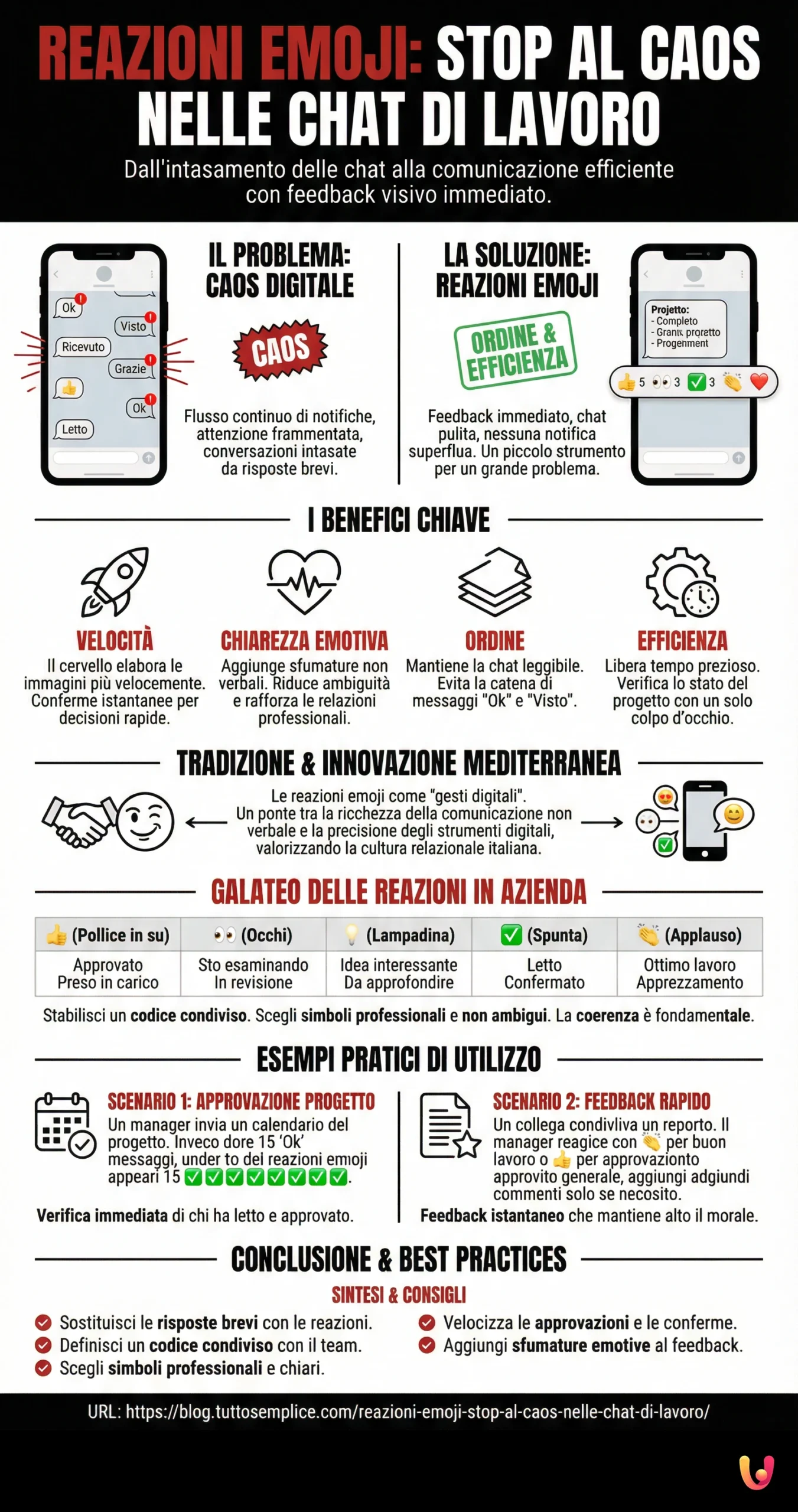
In Mediterranean culture, and particularly in Italian culture, non-verbal communication plays a central role. Gestures, expressions, and tone of voice enrich and often define the meaning of a conversation. This approach, based on direct human interaction, may seem at odds with the apparently cold nature of digital communication. However, emoji reactions represent a bridge between these two worlds, an innovation grafted onto a consolidated tradition. They act as “digital gestures,” a way to reintroduce that emotional and relational component that writing alone cannot convey. The use of an emoji can thus soften a message, express empathy, or create a sense of complicity, mirroring the richness of face-to-face interactions.
The adoption of digital tools like emoji reactions in the Italian and Mediterranean work context shows a growing ability to balance tradition and innovation. If on one hand there is a strong link to a communicative culture based on relationships and expressiveness, on the other hand, technological solutions that improve efficiency and clarity are being embraced. This balance is fundamental for competing in the European market, where speed and organization are essential requirements. Knowing how to communicate effectively, combining the warmth of Mediterranean tradition with the precision of digital tools, becomes a competitive advantage. In this sense, even apparently simple tools like stickers and animated GIFs can, if used professionally, enrich communication.
Creating an “Etiquette” for Reactions in the Company
To fully exploit the benefits of emoji reactions and avoid misunderstandings, it is advisable to define a sort of internal “etiquette” for the company or work team. There are no universal rules, but establishing clear guidelines can make a difference. For example, you can agree that the “thumbs up” 👍 means “task approved and taken charge of,” the lightbulb 💡 means “interesting idea to explore,” and the eyes 👀 mean “I am reviewing the document.” This creates a common language that reduces ambiguity and speeds up understanding. It is important that these rules are shared and understood by everyone, perhaps through a short training session or a reference document.
The choice of emojis to use in a professional context requires attention. It is preferable to opt for universally recognizable symbols with unambiguous meanings. Emojis that are too informal or open to multiple interpretations could be perceived as unprofessional or generate confusion. Consistency with the brand’s tone of voice and company culture is another aspect to consider. A young and informal company might have a more liberal approach, while a more traditional entity might prefer a more restricted and formal set of reactions. The key is always the context and awareness of one’s interlocutor.
Practical Examples of Effective Use
Let’s imagine managing a marketing project. The project manager shares the editorial calendar in a group chat and asks all team members to confirm receipt. Instead of receiving fifteen “Ok” messages, which generate just as many notifications, the manager will see fifteen reactions (for example, ✔️ or 👍) appear directly under their message. At a glance, they will know who has read the document and who is missing. This not only tidies up the chat but drastically simplifies the verification process. The same logic applies to approving a graphic draft or confirming attendance at a meeting.
Another example concerns feedback on a completed activity. A colleague shares a report and a manager, instead of writing a long email, can use a reaction for quick initial feedback. A “thumbs up” 👍 can indicate general approval, while a clapping face 👏 can express appreciation for excellent work. If changes are needed, the manager can add a specific comment, but the initial reaction serves to immediately communicate the general sentiment, reducing waiting anxiety and keeping team morale high. For more structured communications, polls integrated into chats can also be used to gather opinions in an organized way.
- Replace short replies with reactions
Avoid clogging the chat with text messages like ‘Ok’ or ‘Seen’. Use the reaction function to provide immediate feedback without generating superfluous notifications for the whole group.
- Define a shared code with the team
Establish an internal ‘etiquette’ by assigning precise meanings to emojis. For example, agree that the thumbs up means approval and the eyes indicate you are reviewing a document.
- Choose professional and clear symbols
Opt for universally recognizable emojis suitable for your company’s tone. Avoid ambiguous or overly informal symbols that could create confusion or seem unprofessional.
- Speed up approvals and confirmations
Use reactions to confirm receipt of deadlines or approve drafts. This allows managers to verify the project status with a single visual glance.
- Add emotional nuances to feedback
Leverage emojis to reintroduce non-verbal communication. A heart or applause can express appreciation and empathy, making digital interactions more human and less cold.
Conclusions

Message reactions are much more than a simple aesthetic quirk of digital communication; they represent a strategic tool for improving the efficiency, clarity, and quality of professional interactions. In a context like the Italian and European one, where the need for global market speed blends with a Mediterranean culture rich in non-verbal nuances, emoji reactions offer a perfect synthesis. They allow for rapid and organized feedback, reducing digital “noise” and freeing up time for more strategic activities. Embracing this innovation, defining clear rules, and integrating it consciously into the company culture means communicating in a more intelligent, human, and effective way.
Frequently Asked Questions

Reactions are emojis that can be applied directly to a received message without having to write a new reply. They are extremely useful, especially in work groups, because they allow you to give quick feedback (like an ‘ok’, ‘seen’, or ‘thanks’), confirm reading, or express a simple emotion without clogging the chat with superfluous messages. This helps keep the conversation tidy and reduces the number of notifications for all participants.
Yes, in many modern work environments, emoji reactions are considered not only professional but also efficient. However, the appropriateness of their use depends heavily on company culture. A good rule is to observe how colleagues and superiors behave. Generally, universal emojis like the thumbs up (👍), the check mark (✔️), or folded hands (🙏) are widely accepted. For very formal communications or with external contacts, a written response is always preferable.
The secret is to use them with a precise purpose, that is, to replace very short and standard responses. For example, using a reaction to say ‘Ok’, ‘Thanks’, or ‘I saw it’ is an effective way to reduce ‘noise’ in the chat. In groups, they are perfect for quick polls: instead of having ten written answers, you can collect ten reactions to a single message, keeping the discussion clean and easy to follow.
The safest emojis with unambiguous meanings in a professional context include: the thumbs up (👍) for approval or confirmation, the green check mark (✔️) to indicate a completed task, clapping hands (👏) to congratulate, and folded hands (🙏) to say thank you. It is wise to avoid emojis that might be ambiguous, too informal, or open to different cultural interpretations, unless they are already part of the team’s common language.
No, they cannot and should not completely replace text responses. Reactions are ideal for instant feedback and read receipts. However, when it is necessary to discuss complex topics, provide detailed feedback, make important decisions, or leave a formal trail, a well-written message remains irreplaceable. True effectiveness lies in using both tools in a complementary and intelligent way.


Did you find this article helpful? Is there another topic you'd like to see me cover?
Write it in the comments below! I take inspiration directly from your suggestions.