
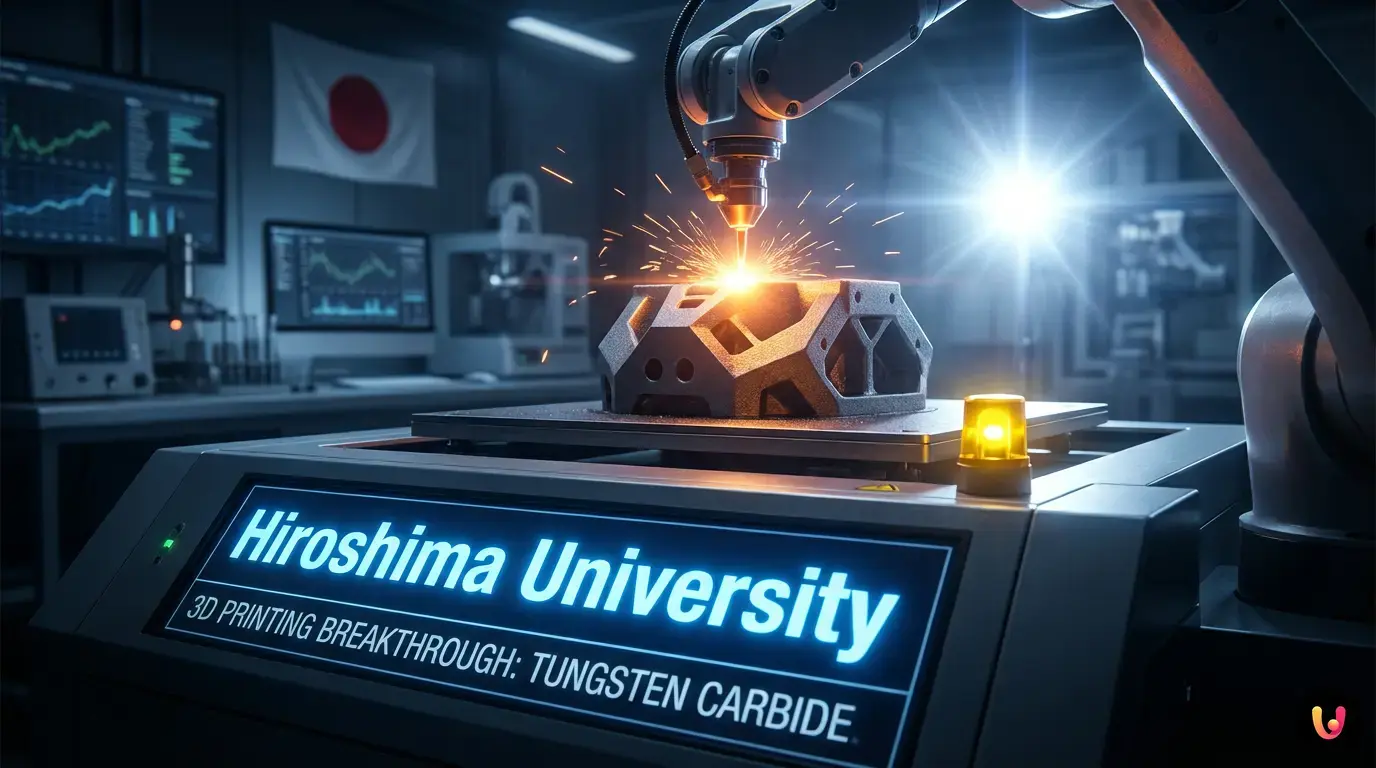
HIROSHIMA, Japan – In a significant leap for the manufacturing and tech sectors, scientists at Hiroshima University have successfully devised a novel method for 3D printing Tungsten Carbide-Cobalt (WC-Co), one of the hardest engineering materials in existence. The breakthrough, announced today, promises to revolutionize the production of industrial tools and components by overcoming the material’s notorious resistance to additive manufacturing.
For decades, Tungsten Carbide-Cobalt has been the gold standard for cutting tools, drill bits, and wear-resistant parts due to its exceptional hardness and durability. However, these same properties have made it incredibly difficult to shape using modern additive manufacturing techniques. According to the research team led by Assistant Professor Keita Marumoto of the Graduate School of Advanced Science and Engineering, the new technique utilizes a "hot-wire laser irradiation" method that softens the material rather than fully melting it, preventing the structural defects that have plagued previous attempts.
Overcoming the Hardness Paradox
The central challenge in 3D printing super-hard materials lies in their thermal properties. Traditional laser sintering methods often cause WC-Co to crack or form brittle phases due to the extreme thermal gradients involved in melting and rapid cooling. Consequently, the industry has relied on powder metallurgy—a process involving high-pressure molds and sintering furnaces—which is not only energy-intensive but also wasteful and expensive, particularly for small-batch production.
The Hiroshima University team took a different approach. Instead of using a powder bed, they employed a hot-wire method combined with laser irradiation. According to the study published in the International Journal of Refractory Metals and Hard Materials, this technique allows for precise control over the heat input. By heating the wire to a malleable state without fully liquefying it, the researchers achieved a defect-free build with a Vickers hardness exceeding 1400 HV, rivaling commercially available counterparts.
"The approach of forming metal materials by softening them rather than fully melting them is novel," Marumoto stated, noting that this method could potentially be applied to other difficult-to-print alloys. This innovation marks a turning point for industries that require custom, high-performance tooling but cannot justify the high costs of traditional mold-making.
Impact on Startups and Agile Manufacturing
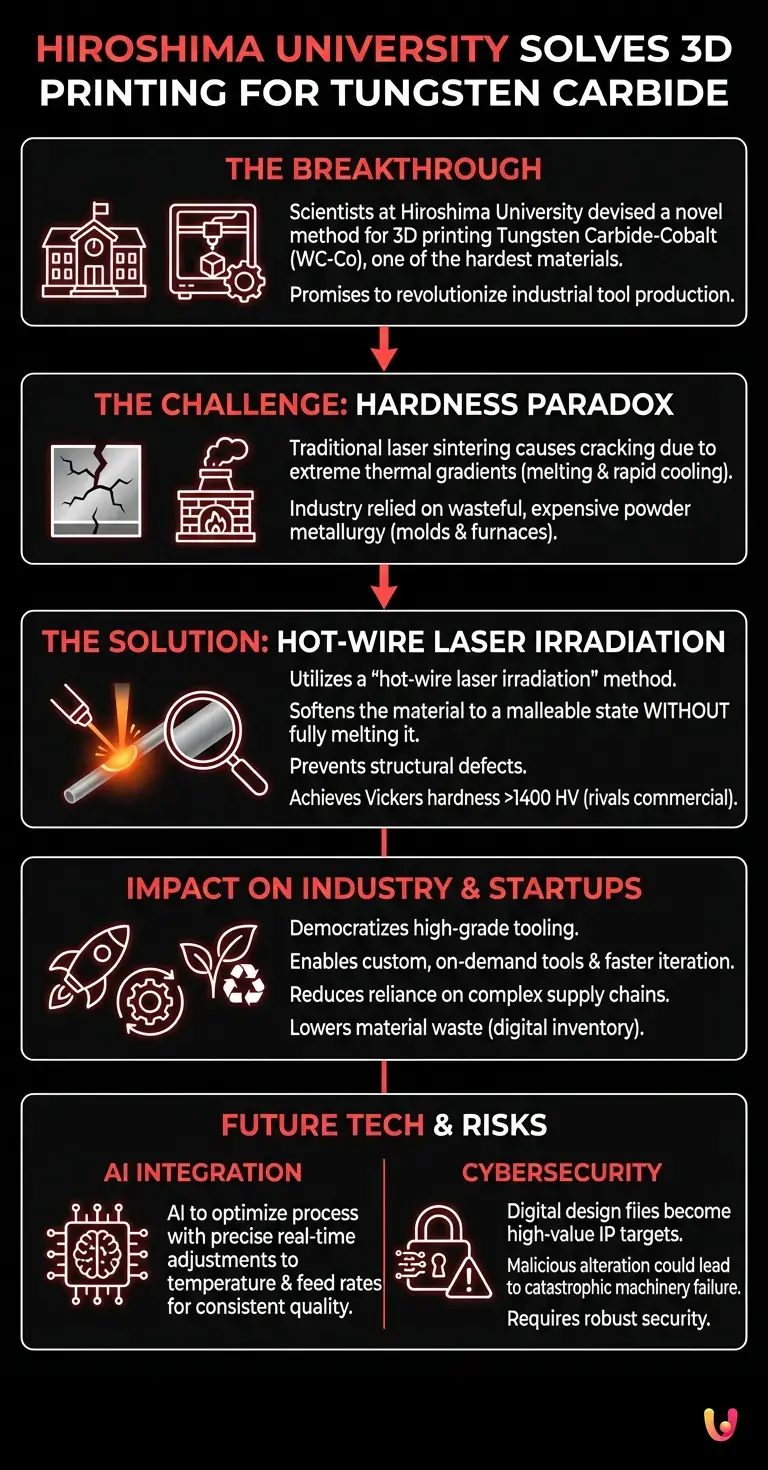
The democratization of high-grade industrial tooling could have profound effects on the hardware ecosystem, particularly for startups. Historically, the high cost of tungsten carbide tooling created a barrier to entry for small companies developing physical products. With the ability to 3D print custom cutting tools or wear parts on demand, startups can iterate faster and reduce their reliance on complex, slow-moving supply chains.
Furthermore, this advancement aligns with the broader trend of digital manufacturing, where physical inventories are replaced by digital files printed only when needed. This shift reduces material waste significantly, addressing one of the primary environmental criticisms of heavy industry. The Hiroshima University researchers highlighted that their method drastically lowers the amount of raw tungsten and cobalt required, materials that are both expensive and subject to supply chain volatility.
The Role of AI and Future Tech
As this technology matures, the integration of AI (Artificial Intelligence) is expected to play a critical role in optimizing the printing process. The hot-wire laser irradiation technique requires precise real-time adjustments to temperature and feed rates to maintain the material’s "softened" state without crossing into the liquid phase. Future iterations of these printers will likely employ AI-driven control systems to monitor thermal data and adjust parameters on the fly, ensuring consistent quality across complex geometries.
This convergence of materials science and software is reshaping the tech landscape, moving additive manufacturing from prototyping plastics to producing mission-critical metal components. The ability to print geometries that were previously impossible to cast or machine opens new doors for aerospace, automotive, and medical device engineering.
Cybersecurity in the Digital Supply Chain
However, the digitization of such critical manufacturing processes introduces new risks. As the production of high-hardness industrial tools moves toward a "print-on-demand" model, the intellectual property (IP) contained within the digital design files becomes a high-value target. Cybersecurity experts warn that as additive manufacturing capabilities expand to include strategic materials like tungsten carbide, protecting the digital supply chain will be paramount.
Ensuring the integrity of these files is not just about preventing theft; it is about safety. A malicious alteration to the print parameters of a high-stress component could lead to catastrophic failure in industrial machinery. As organizations adopt these advanced manufacturing technologies, they must simultaneously invest in robust cybersecurity frameworks to verify the authenticity and integrity of their build files.
In Brief (TL;DR)
Hiroshima University scientists have developed a revolutionary method to successfully 3D print Tungsten Carbide-Cobalt, overcoming historical manufacturing limitations.
The innovative hot-wire laser irradiation technique softens the material rather than melting it, preventing structural defects common in traditional sintering.
This breakthrough democratizes high-performance tooling production, reducing material waste and enabling agile manufacturing for startups and heavy industries alike.
Conclusion
The achievement by Hiroshima University represents more than just a technical milestone; it is a fundamental shift in how we approach the manufacturing of extreme materials. By successfully 3D printing Tungsten Carbide-Cobalt, the researchers have unlocked new possibilities for efficiency, customization, and sustainability in heavy industry. As this technology transitions from the lab to the factory floor, it will likely serve as a catalyst for further innovations in AI-driven manufacturing and secure digital supply chains, proving once again that the future of hardware lies in the intelligent application of advanced materials.
Frequently Asked Questions

Unlike traditional laser sintering that melts powder, this new technique heats a wire to a malleable state without fully liquefying it. This approach prevents the structural defects and cracking often caused by extreme thermal gradients in super-hard materials like Tungsten Carbide-Cobalt.
This material is known for its extreme hardness and durability, which creates significant challenges regarding thermal properties during the printing process. Standard methods often result in brittle phases or cracks due to rapid heating and cooling, forcing industries to rely on expensive and wasteful molding processes instead.
This innovation democratizes access to high-grade industrial tooling by removing the high costs associated with traditional mold-making. Startups can now produce custom cutting tools or wear parts on demand, allowing for faster iteration and reduced reliance on complex supply chains.
AI is expected to play a crucial role by managing the precise real-time adjustments needed for temperature and feed rates. By monitoring thermal data, AI-driven systems ensure the material remains in a softened state without melting, guaranteeing consistent quality across complex geometries.
The shift to digital manufacturing turns design files into high-value targets for intellectual property theft. Furthermore, malicious alterations to print parameters could compromise the structural integrity of tools, potentially leading to catastrophic machinery failures, making file verification essential.
Sources and Further Reading



Did you find this article helpful? Is there another topic you'd like to see me cover?
Write it in the comments below! I take inspiration directly from your suggestions.