

In an era where high-definition video calls, endless social media feeds, and immersive virtual environments are the norm, it is easy to take the seamless flow of digital information for granted. Yet, beneath the surface of every vibrant display lies a profound secret that prevents our global network from collapsing under its own weight. The unsung hero of this digital stability is perceptual compression, a sophisticated technique that creates a deceptive pixel illusion. Without this ingenious technological sleight of hand, the internet as we know it would grind to an agonizing halt.
To truly understand how the modern web functions, we must look past the crisp images and fluid videos on our screens. What you are seeing is not a perfect replica of reality, but rather a highly optimized, mathematically calculated deception. This article explores the mechanics of this illusion, the biological quirks it exploits, and why the future of global communication relies entirely on our ability to keep faking it.
The Crushing Weight of Raw Data
To grasp why this deceptive pixel illusion is necessary, we first need to understand the sheer scale of raw digital media. A single digital image is made up of millions of tiny squares called pixels. In a standard uncompressed format, each pixel requires three bytes of data to represent the exact mixture of red, green, and blue light needed to display its specific color.
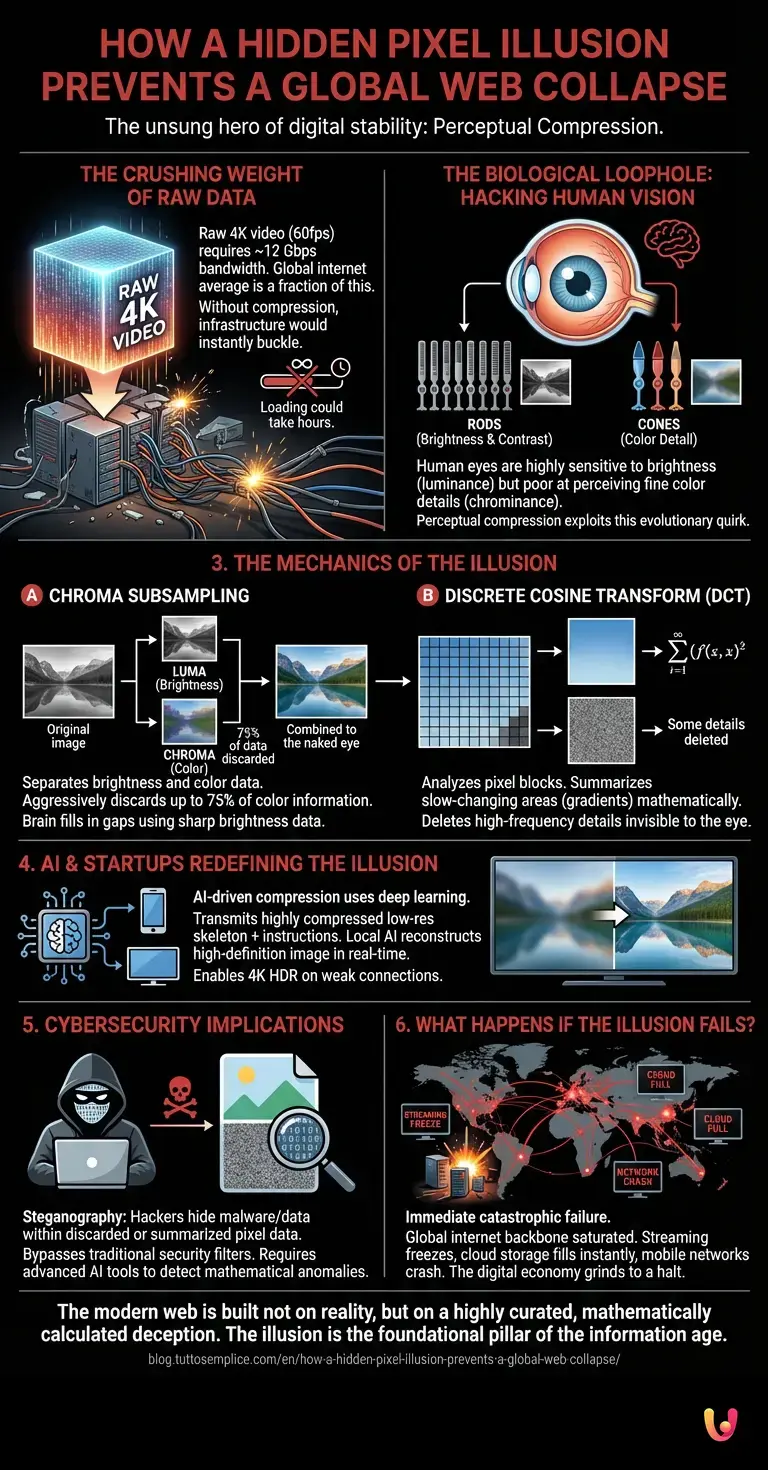
Consider a standard 4K video, which boasts a resolution of 3840 by 2160 pixels. That equates to over 8.2 million pixels per frame. If you are watching a video at a standard 60 frames per second, your device is processing nearly half a billion pixels every single second. In raw, uncompressed data terms, streaming a 4K video would require a bandwidth of approximately 12 gigabits per second (Gbps). To put that into perspective, the average global internet connection speed hovers around a mere fraction of that amount.
If the internet were forced to transmit every single pixel of every image and video in its raw, unadulterated form, the global telecommunications infrastructure would instantly buckle. Fiber-optic cables would be overwhelmed, servers would melt down under the processing load, and loading a single webpage could take hours. The internet simply cannot handle the truth. Therefore, it relies on a brilliant lie.
The Biological Loophole: Hacking Human Vision
The secret behind this massive data reduction lies not just in computer science, but in human biology. The engineers who built the foundations of digital media realized early on that they did not need to transmit a perfect image; they only needed to transmit an image that looked perfect to the human eye. This is the core philosophy of perceptual compression.
The human retina is lined with two types of photoreceptor cells: rods and cones. Rods are highly sensitive to changes in brightness and contrast (luminance), allowing us to see shapes, textures, and movement even in low light. Cones, on the other hand, are responsible for perceiving color (chrominance), but there are far fewer of them, and they are less sensitive to fine details.
Because of this evolutionary quirk, human vision is incredibly sharp when it comes to black-and-white detail, but surprisingly blurry when it comes to color detail. We simply cannot process high-frequency color changes as effectively as we process changes in brightness. This biological loophole is the exact vulnerability that the deceptive pixel illusion exploits.
The Mechanics of the Illusion: Chroma Subsampling and the DCT

How does this biological hack translate into technology? The process begins with a technique called chroma subsampling. When an image or video is captured, the compression algorithm separates the brightness data (luma) from the color data (chroma). Because our eyes are terrible at noticing fine color details, the algorithm aggressively throws away up to 75% of the color information.
It keeps the brightness data completely intact, ensuring that the edges, textures, and shapes remain razor-sharp. Then, it essentially stretches the remaining color data over the image. Because the structural details are preserved by the brightness data, your brain seamlessly fills in the gaps, completely unaware that the majority of the color pixels are actually missing. This alone cuts the file size in half without any perceptible loss in quality.
But the illusion does not stop there. The algorithm then applies a mathematical process known as the Discrete Cosine Transform (DCT). The DCT analyzes blocks of pixels and identifies areas where the visual information changes very slowly, like a clear blue sky. Instead of saving every individual blue pixel, the algorithm records a mathematical summary of the gradient. It also identifies high-frequency details that the human eye cannot easily perceive and simply deletes them. The result is an image that is a fraction of its original size, yet appears identical to the naked eye.
How AI and Startups are Redefining the Illusion
While traditional compression algorithms like JPEG and H.264 have kept the internet running for decades, the explosion of data in the modern era requires even more aggressive solutions. This is where the latest advancements in tech come into play. Today, a new generation of agile startups is leveraging the power of AI to push the boundaries of the deceptive pixel illusion further than ever before.
Instead of merely discarding data, modern AI-driven compression uses deep learning and neural networks to predict and generate pixels on the fly. When a video is transmitted, the sender does not send the full image. Instead, it sends a highly compressed, low-resolution skeleton of the image, along with a set of instructions. The AI on the receiver’s end (your smartphone or smart TV) uses these instructions to hallucinate the missing details, reconstructing a high-definition image in real-time.
This kind of innovation is revolutionary. It allows for crystal-clear video calls over incredibly weak cellular connections and enables streaming platforms to deliver 4K HDR content at a fraction of the traditional bandwidth cost. By shifting the heavy lifting from data transmission to local AI processing, these startups are ensuring that the internet can continue to scale alongside our insatiable appetite for media.
The Cybersecurity Implications of Hidden Pixels
While perceptual compression is a miracle of modern engineering, the manipulation of pixels also opens up fascinating and complex challenges in the realm of cybersecurity. Because compression algorithms are designed to hide data in plain sight, malicious actors have learned to exploit this very same mechanism.
Through a technique known as steganography, hackers can embed malicious code, malware, or stolen data within the discarded or mathematically summarized pixel data of an image. Because the human eye cannot detect the subtle changes in the image, and because standard antivirus software often struggles to analyze the complex mathematics of compressed media files, these weaponized images can easily bypass traditional security filters.
Consequently, cybersecurity experts are now developing advanced AI tools designed specifically to analyze the mathematical integrity of compressed files. They are looking for anomalies in the DCT coefficients or unusual patterns in the chroma subsampling that might indicate the presence of hidden payloads. The battleground of digital security has literally moved into the microscopic, invisible spaces between the pixels.
What Happens If the Illusion Fails?
It is worth pondering what would happen if this deceptive pixel illusion were suddenly turned off. If a bug or a malicious attack were to disable perceptual compression across the web, the consequences would be immediate and catastrophic.
Within seconds, the global internet backbone would become saturated. Streaming services would freeze, unable to push the massive uncompressed video files through the pipes. Cloud storage data centers would run out of space almost instantly. Mobile networks would crash as cell towers attempted to transmit gigabytes of raw data to individual smartphones. The digital economy, which relies on high-speed, low-latency communication, would grind to a halt.
This hypothetical scenario underscores a vital truth about our modern world: our technological infrastructure is not built to handle reality. It is built to handle a highly curated, mathematically compressed version of reality. The illusion is not just a neat trick; it is the foundational load-bearing pillar of the information age.
In Brief (TL;DR)
The internet avoids collapsing under the massive weight of raw digital media by relying on perceptual compression to create a deceptive pixel illusion.
Perceptual compression deliberately exploits biological loopholes in human vision, taking advantage of our natural inability to process fine color details compared to brightness.
By aggressively discarding color data and using mathematical summaries for pixel blocks, compression algorithms drastically reduce file sizes without sacrificing perceived visual quality.
Conclusion

The deceptive pixel illusion is a testament to human ingenuity. By understanding the limitations of our own biology, engineers have managed to trick our eyes, shrink our data, and build a globally connected society that defies the physical limitations of bandwidth. From the early days of chroma subsampling to the cutting-edge AI reconstruction techniques pioneered by modern startups, perceptual compression remains the silent guardian of the digital realm.
As we move toward a future filled with virtual reality, augmented reality, and even higher-resolution displays, the need for this illusion will only grow. The next time you stream a movie, scroll through a photo gallery, or join a video conference, take a moment to appreciate the invisible magic happening behind the glass. You are not seeing the whole picture, and that is exactly why the internet continues to work.
Frequently Asked Questions

Perceptual compression is a sophisticated technique that reduces file sizes by exploiting the limitations of human vision. It discards visual data that our eyes cannot easily detect, such as fine color details, while preserving essential brightness and structural information. This mathematical deception significantly lowers bandwidth requirements without noticeably reducing image quality.
The internet would collapse because raw digital media requires an enormous amount of bandwidth that current global infrastructure cannot support. For example, streaming an uncompressed high definition video would demand around twelve gigabits per second, which far exceeds average connection speeds. Without compression algorithms reducing these massive files, servers would crash and basic web pages would take hours to load.
Chroma subsampling reduces file sizes by separating an image into brightness and color data and then aggressively discarding up to seventy five percent of the color information. Because human eyes are highly sensitive to brightness but poor at perceiving fine color details, our brains naturally fill in the missing gaps. This biological loophole allows the file size to be cut in half while maintaining a sharp appearance to the naked eye.
Artificial intelligence startups are improving video streaming by using deep learning networks to predict and generate missing pixels in real time. Instead of transmitting a full video file, the sender transmits a highly compressed skeleton along with specific instructions for the receiving device. The local artificial intelligence then reconstructs the high definition image on the fly, allowing for crystal clear media delivery even over weak cellular connections.
Hackers use a technique called steganography to embed malicious code or stolen data within the discarded or mathematically summarized pixel data of an image. Because these subtle changes are invisible to the human eye and difficult for standard antivirus software to detect, weaponized images can easily bypass traditional security filters. Cybersecurity experts are currently developing advanced tools to analyze the mathematical integrity of compressed files to stop these hidden threats.
Still have doubts about How a hidden pixel illusion prevents a global web collapse?
Type your specific question here to instantly find the official reply from Google.
Sources and Further Reading






Did you find this article helpful? Is there another topic you’d like to see me cover?
Write it in the comments below! I take inspiration directly from your suggestions.