

In Brief (TL;DR)
Leveraged and short ETFs are complex instruments that, due to mechanisms like daily compounding, hide significant risks, making them unsuitable for long-term investments.
We analyze the mechanism of ‘daily compounding’ (beta-slippage) and why these financial instruments are not suitable for long-term investments.
Delve into the danger of ‘daily compounding’ (or beta-slippage) and discover why it can erode your long-term returns.
The devil is in the details. 👇 Keep reading to discover the critical steps and practical tips to avoid mistakes.
In the world of investing, ETFs (Exchange Traded Funds) have become a familiar tool for many savers. They are appreciated for their simplicity, low costs, and ability to diversify with a single purchase. However, there is a particular category of ETF that deviates significantly from this reassuring image: leveraged and structured ETFs. These financial instruments, often presented as a way to amplify gains, hide complex mechanisms and significant risks that can turn a promising investment into a rapid loss of capital. Imagine them not as a sturdy family car, but as a Formula 1 single-seater: extremely powerful in the right hands and on a suitable track, but extremely dangerous for those who don’t know how to drive it thoroughly.
These financial products are the result of sophisticated financial engineering and are aimed at an audience of expert traders, not the traditional investor who patiently builds their future, as is common in a culture of saving. Understanding how they work is the first step to avoiding unpleasant surprises and understanding why, in most cases, they are not suitable for a long-term portfolio. The goal of this article is to reveal the internal mechanics of these instruments, with a particular focus on the risks related to the time horizon and market volatility.
What Are Leveraged and Structured ETFs?
Before diving into the risks, it’s crucial to understand the difference between a traditional ETF and a leveraged one. A classic ETF simply replicates the performance of a benchmark index (like the FTSE MIB or the S&P 500). If the index goes up by 1%, the ETF goes up by about 1%, and vice versa. Its logic is linear and intuitive. Leveraged ETFs, on the other hand, use financial derivatives like swaps and futures to multiply the daily performance of the underlying index. This makes them inherently more complex and speculative instruments.
Leveraged ETFs: Multiplying Returns (and Losses)
A leveraged ETF aims to generate a return that is a multiple of its benchmark, but only on a daily basis. There are ETFs with 2x, 3x, or even higher leverage, which aim to double or triple daily gains. For example, if the benchmark index gains 2% in one day, a 2x leveraged ETF should gain 4%. There are also “short” or “inverse” ETFs, which work in the opposite way: they gain when the market goes down. A -1x short ETF, for example, will gain 1% if the index loses 1%. The promise of amplified returns is tempting, but leverage works in both directions: if the index loses 2%, the 2x leveraged ETF will lose 4%, drastically amplifying losses.
Structured ETFs: Beyond Simple Replication
Structured ETFs represent an even broader and more complex category. While leveraged ETFs are a subcategory, the term “structured” can include products with very different strategies that go beyond simple performance multiplication. They can incorporate options, caps on gains or losses, or strategies aimed at achieving returns under specific market conditions. Their complexity is such that CONSOB, Italy’s market regulator, has repeatedly called attention to their distribution to retail clients, highlighting the difficulty in understanding their risk/return profile. Given their nature, they require even more in-depth financial knowledge.
The Vicious Mechanism: How Daily Leverage Works
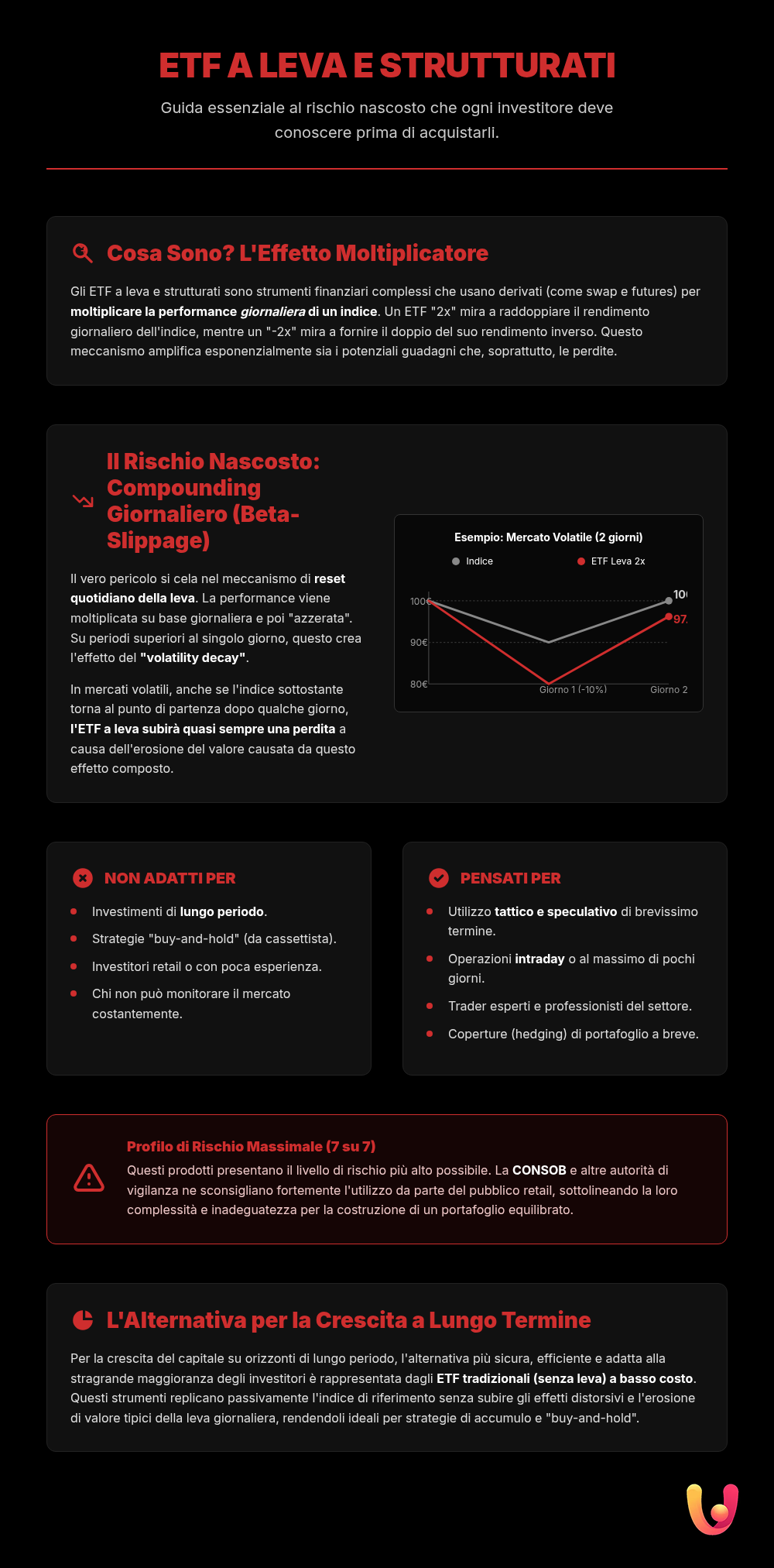
The true heart of the risk in leveraged ETFs lies in a technical detail that is often overlooked: the daily reset of leverage. This mechanism is the main cause of the so-called “compounding effect” or “beta-slippage,” a phenomenon that can erode the value of the investment over time, even if the underlying index appears to be moving in a favorable direction.
The Daily Reset: The Key to Everything
The leverage of these ETFs is recalculated every single day. The fund manager’s goal is to ensure that, at the end of each trading session, the ETF’s performance is exactly the multiple (e.g., 2x) of the index’s performance on *that* day. To do this, the manager must continuously buy or sell the underlying assets (or derivatives) to realign the exposure. If the market goes up, they must increase exposure to maintain the leverage; if it goes down, they must sell a portion. This process, repeated day after day, triggers a perverse mathematical effect over time horizons longer than a single day.
The Compounding Effect (Beta-Slippage): The Hidden Risk
The compounding effect is a powerful force in finance. Unfortunately, in the case of leveraged ETFs, it often works against the investor. Due to the daily reset, the ETF’s performance over a period of several days will not simply be the index’s performance multiplied by the leverage. In a volatile market with constant ups and downs, this phenomenon, also known as beta-slippage or volatility decay, erodes capital in an almost irreversible way.
Let’s consider a practical example. An index starts at 100. Day 1: it rises by 10% to 110. Day 2: it falls by 9.09%, returning to 100. The investor who bet on the index is back to square one. Now let’s look at a 2x leveraged ETF. Day 1: the index is up +10%, so the ETF is up +20%, rising from 100 to 120. Day 2: the index is down -9.09%, so the ETF is down -18.18%. Its value drops to 98.18 (120 – 18.18%). Although the index has returned to 100, the leveraged ETF has lost almost 2%.
This erosion is greater the higher the market volatility and the longer the investment time horizon. This is the main reason why these instruments are unsuitable for long-term strategies.
Why Leveraged ETFs Are Not for Everyone
The very nature of leveraged ETFs makes them incompatible with the approach of the traditional, “buy-and-hold” investor. The Mediterranean savings culture, based on patience, gradual growth, and capital protection, is the antithesis of the speculative philosophy required by these instruments. They are products designed for tactical, very short-term use, suitable only for expert traders who constantly monitor their positions.
The Time Horizon: The Decisive Factor
As the compounding effect demonstrates, holding a leveraged ETF in a portfolio for weeks, months, or years is almost always a losing strategy, unless the market is strongly directional with low volatility. These instruments are designed for intraday bets or, at most, for trades lasting a few days. Those looking for a solution to grow their savings over time should turn to traditional ETFs, which passively track the market without the distorting effects of daily leverage. The idea of “buy and forget” is a recipe for disaster with a leveraged ETF.
Risk Profile: Only for Expert Investors
Leveraged ETFs are classified as complex financial products and almost always have the highest synthetic risk indicator (7 out of 7). This means they are suitable only for investors with a high risk tolerance, a deep understanding of financial markets, and the ability to withstand potentially large and rapid losses. Francesco Zinghinì, an engineer with experience in quantitative trading, points out that “the financial engineering behind these products creates a ‘time decay’ that many do not understand. They are tools for specialists, not for the general public.” The improper use of these ETFs is one of the most common traps for inexperienced investors attracted by the promise of easy and fast gains.
A Practical Example: Tradition vs. Financial Innovation
To illustrate the difference between a traditional and a speculative approach, let’s imagine two friends, Mario and Luca. Both decide to invest 10,000 euros in the Italian stock index FTSE MIB, but with different instruments. Mario, a prudent saver, buys a traditional ETF that tracks the index. Luca, fascinated by innovation and seeking quick gains, chooses a 2x leveraged ETF on the same index. Let’s assume a week of very volatile markets, a not uncommon phenomenon.
Monday: the FTSE MIB gains 3%. Mario’s portfolio rises to 10,300 euros (+3%). Luca’s rises to 10,600 euros (+6%). Luca is euphoric. Tuesday: the market corrects and loses 4%. Mario’s portfolio drops to 9,888 euros (-4% of 10,300). Luca suffers a double loss, -8%, and his capital falls to 9,752 euros. Wednesday: there’s a 2% rebound. Mario’s portfolio recovers to 10,086 euros. Luca gains 4% and reaches 10,142 euros. Thursday: another negative day, with the index losing 2%. Mario’s value becomes 9,884 euros. Luca’s, losing 4%, drops to 9,736 euros. Friday: the market ends the week with a 1% recovery. At the end of the week, Mario’s portfolio is worth 9,983 euros, with a contained loss of 0.17%. The index, in fact, has almost returned to its starting point. Luca, however, ends at 9,931 euros, with a loss of 0.69%, almost four times that of his friend. This example shows how, in a volatile and directionless market, capital erosion (beta-slippage) heavily penalizes the leveraged ETF.
Alternatives and Protection Strategies
If leveraged ETFs are not the answer for the average investor, what are the correct alternatives? The first rule is always the same: choose instruments appropriate for your goals and risk profile. For long-term capital growth, a modern, diversified portfolio, based on low-cost traditional ETFs, remains the wisest and most proven choice. These instruments allow you to participate in the growth of global markets without exposing yourself to the destructive risks of daily leverage.
For more sophisticated investors who wish to speculate or hedge specific positions, there are more direct and transparent alternatives, such as call and put options. Although they are also complex, they do not suffer from the daily compounding effect and allow for a more precise definition of risk and potential return. In any case, it is crucial to understand the nature of market volatility; tools like the VIX index, known as the “fear index,” can offer valuable insights into trader nervousness, a factor that amplifies the risks of leveraged ETFs. Education and awareness are the best forms of protection.
Conclusion

Leveraged and structured ETFs are powerful financial instruments, but their power is a double-edged sword. Created to meet the needs of professional traders for very short-term tactical operations, they have often been aggressively marketed to an unprepared public, attracted by the promise of exceptional returns. The reality, however, is that their daily reset mechanism and the resulting compounding effect make them unsuitable, and often harmful, for anyone with a time horizon longer than a few days.
For investors whose financial culture is historically tied to prudence and patient value creation, these products represent a dangerous deviation. True innovation does not lie in seeking risky shortcuts, but in building solid, diversified portfolios capable of weathering market storms and generating sustainable growth over time. Before venturing into complex instruments, it is essential to invest in your own financial education: it is the only investment that always guarantees a positive return.
Frequently Asked Questions

A leveraged ETF is a financial instrument that aims to multiply the daily returns of a benchmark index, like the FTSE MIB. If the index gains 1% in a day, a 2x leveraged ETF will aim for a 2% gain. But be careful: the same multiplication applies to losses. They use derivatives to achieve this goal and are intended for very short-term trades, not to be held for long periods.
Technically, yes, but it is strongly discouraged for the average investor. These instruments are designed for daily trading strategies. Holding them for multiple days exposes you to the risk of ‘daily compounding’ (or beta-slippage), an effect where, due to the daily recalculation of leverage, the overall return can be very different from, and often lower than, what you would expect, especially in volatile markets.
It is the main risk of leveraged and short ETFs. Since the leverage is ‘reset’ every day, performance does not add up linearly over time. In a market that goes up and down, even if the underlying index returns to its starting point after a few days, the leveraged ETF will most likely have lost value. This ‘slippage’ can significantly erode capital over periods longer than a single day.
Absolutely not. A ‘buy-and-hold’ investor aims for long-term capital growth, a strategy incompatible with the nature of leveraged ETFs. The latter are tactical tools for expert traders who use them for very short-term speculation. Regulatory authorities like CONSOB (in Italy) and ESMA (in Europe) warn retail investors about the risks of complex financial products like these.
A regular ETF passively tracks the performance of an index (if the index is up +1%, the ETF is up about +1%). A leveraged ETF, on the other hand, uses derivatives to amplify this performance on a daily basis (if the index is up +1%, a 2x leveraged ETF aims for +2%). Consequently, leveraged ETFs have much higher risks, usually higher management fees, and are only suitable for constant monitoring and active trading strategies, unlike traditional ETFs which are ideal for long-term, diversified investments.


Did you find this article helpful? Is there another topic you'd like to see me cover?
Write it in the comments below! I take inspiration directly from your suggestions.