

The MacBook Air has long been the crown jewel of Apple’s consumer laptop lineup, balancing portability with impressive power. As the tech world looks toward the spring of 2026, anticipation is building for the next iteration of this beloved device. However, recent reports suggest that the upcoming M5 model may not be the radical reinvention some enthusiasts were hoping for. Instead, it appears Apple is preparing for a straightforward “spec bump,” focusing on internal silicon improvements rather than a design overhaul.
While a faster chip is always welcome, industry commentators are pointing out that raw speed isn’t the only metric that matters. According to a recent analysis by 9to5Mac, there is one specific upgrade that could fundamentally change the MacBook Air experience, yet it remains uncertain if Apple will implement it. As the M5 chip promises to push performance boundaries even further, the conversation has shifted from “how fast is it?” to “can it handle the heat?”
The Reality of the M5 “Spec Bump”
Current rumors indicate that the 2026 MacBook Air will retain the familiar design language introduced with the M2 generation in 2022. According to Macworld, the primary change will be the transition to the next-generation M5 silicon. This new chip is expected to deliver significant performance gains, with reports citing a 15-25% increase in CPU speeds and a massive 45% boost in graphics performance compared to the M4. Additionally, the M5 is rumored to feature a substantially more powerful Neural Engine, designed to accelerate on-device AI tasks and support the latest features of Apple Intelligence.
Despite these internal advancements, the external chassis is expected to remain virtually identical. Users can likely expect the same 13-inch and 15-inch size options, the same port selection, and the same Liquid Retina display. For many, this continuity is a positive sign of a mature product. However, as software demands grow—driven by complex AI workflows and high-end gaming—the limitations of the current hardware design are becoming a focal point for critics.
The Missing Piece: Advanced Thermal Management
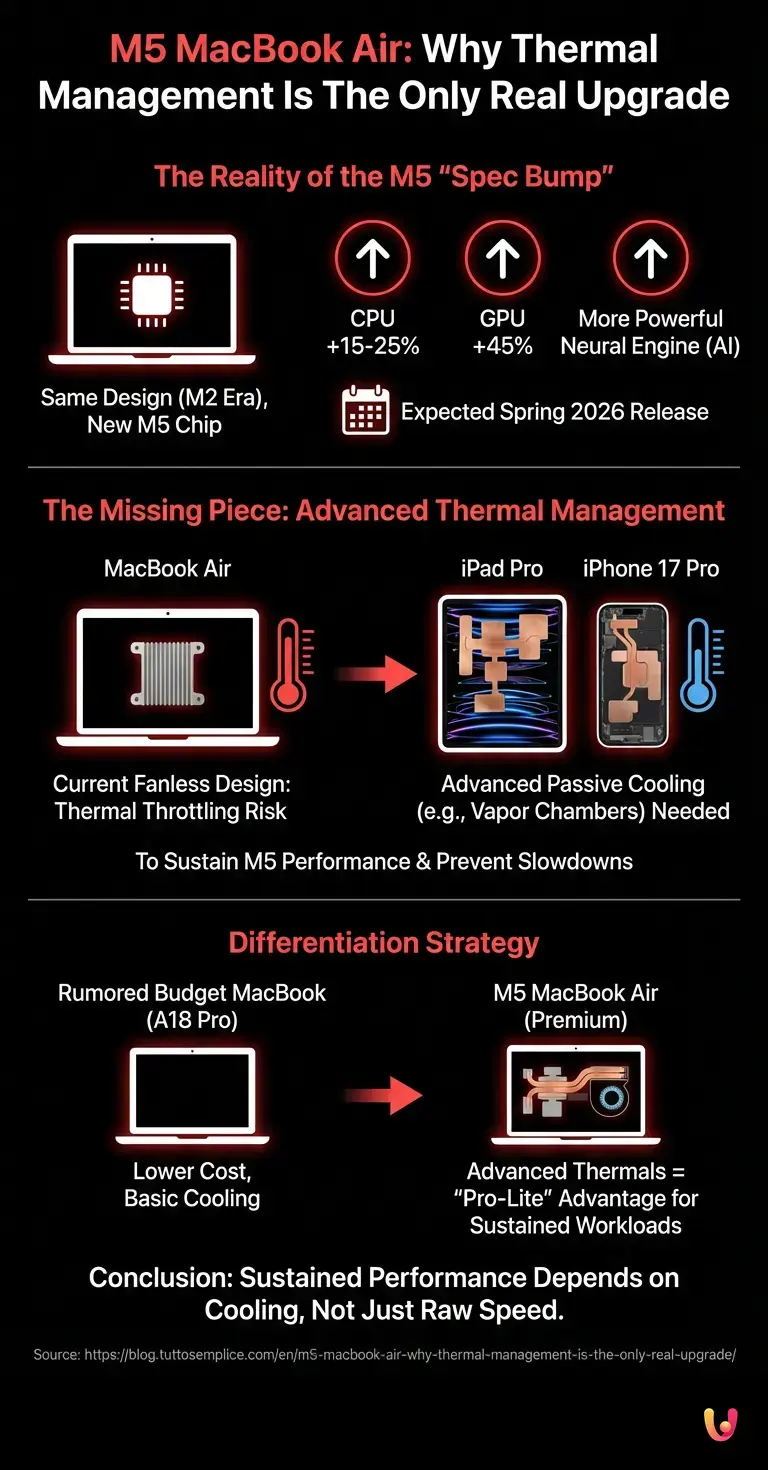
The defining characteristic of the modern MacBook Air is its fanless design, which ensures silent operation. However, this silence comes at a cost: thermal throttling. According to Michael Burkhardt of 9to5Mac, the “one upgrade” that the M5 MacBook Air desperately needs is not a better screen or more ports, but improved passive cooling. Burkhardt argues that while Apple has prioritized thermal solutions in other recent devices, the MacBook Air has been left behind.
The report highlights a discrepancy in Apple’s engineering priorities. The latest iPad Pro and the iPhone 17 Pro have both received sophisticated thermal upgrades, such as copper heat spreaders and vapor chambers, to sustain peak performance during intensive tasks. In contrast, the MacBook Air relies on a simpler heat dissipation method that can lead to reduced performance during sustained workloads. As the M5 chip becomes more powerful, the heat it generates will inevitably rise, making efficient passive cooling more critical than ever to prevent the processor from slowing down to protect itself.
Differentiation in a Crowded Lineup

Implementing better thermal management would serve a strategic purpose beyond just performance: product differentiation. Rumors have been circulating about a potential new “budget” MacBook powered by an A18 Pro chip, which would sit below the Air in the lineup. According to 9to5Mac, if both the budget model and the premium Air suffer from similar thermal constraints, the value proposition of the more expensive Air becomes muddled. By adding a vapor chamber or a more advanced heat sink to the M5 MacBook Air, Apple could offer a tangible “pro-lite” advantage for users who need sustained power for video editing or coding but don’t want the bulk of a MacBook Pro.
In Brief (TL;DR)
The upcoming M5 MacBook Air is expected to feature powerful internal silicon upgrades while retaining its familiar external design and size options.
Experts argue that advanced passive cooling is critical to preventing thermal throttling and unlocking the full potential of the new M5 processor.
Implementing superior thermal management strategies would ensure sustained performance for demanding AI workflows and differentiate the device from entry-level models.
Conclusion

As we approach the expected release in spring 2026, the M5 MacBook Air is shaping up to be a powerhouse of efficiency, even if it lacks a fresh new look. While the allure of a simple processor upgrade is strong, the argument for improved thermals is undeniable. If Apple chooses to integrate the advanced cooling technologies seen in its mobile devices, the M5 Air could finally bridge the gap between silent operation and sustained professional performance. Until then, buyers may have to decide if a spec bump alone is enough to warrant an upgrade.
Frequently Asked Questions

Current industry reports and rumors point toward a release in the spring of 2026. This launch timeline suggests Apple is following a specific cycle for its silicon updates. While enthusiasts await the device, expectations are set for a specification improvement rather than a complete visual overhaul, maintaining the schedule established by previous generations.
Most sources indicate that the M5 model will retain the external design language introduced with the M2 generation in 2022. Users should expect the same 13-inch and 15-inch size options, port selection, and Liquid Retina display. The primary changes are anticipated to be internal, focusing specifically on the transition to the next-generation M5 silicon rather than aesthetic alterations to the chassis.
Thermal management is vital because the MacBook Air utilizes a fanless design for silent operation. As the M5 chip delivers projected performance gains of up to 25 percent in CPU and 45 percent in graphics, the device generates more heat. Without advanced passive cooling solutions like vapor chambers or copper heat spreaders, the processor may be forced to slow down, or throttle, to prevent overheating during sustained workloads like AI tasks or gaming.
The M5 silicon is rumored to offer significant performance leaps over its predecessors. Reports suggest a 15 to 25 percent increase in CPU speeds and a substantial 45 percent boost in graphics performance compared to the M4 generation. Additionally, a more powerful Neural Engine is expected to accelerate on-device AI capabilities, though realizing this full potential depends heavily on the ability of the device to manage heat effectively.
Rumors suggest Apple may introduce a lower-cost laptop powered by an A18 Pro chip, sitting below the Air lineup. This creates a need for the M5 MacBook Air to differentiate itself significantly. If the premium Air lacks advanced thermal management, its sustained performance might not sufficiently justify the price gap compared to this potential budget model, making the inclusion of better cooling technology a strategic necessity for product differentiation.
Sources and Further Reading

- Wikipedia: Apple Silicon – Overview of Apple’s ARM-based processors
- Wikipedia: MacBook Air – History and specifications of the product line
- Wikipedia: Thermal management in electronics – Principles of heat dissipation and cooling
- Wikipedia: Dynamic frequency scaling – Explanation of processor throttling for thermal control



Did you find this article helpful? Is there another topic you'd like to see me cover?
Write it in the comments below! I take inspiration directly from your suggestions.