
In Brief (TL;DR)
SEO for YMYL sectors requires rigorous prompt engineering to avoid hallucinations and meet Google quality criteria.
Advanced techniques like Chain-of-Thought and context injection transform probabilistic models into reliable tools for complex financial data.
Orchestration via Python and API allows for mathematical validation of content by separating real calculation from text generation.
The devil is in the details. 👇 Keep reading to discover the critical steps and practical tips to avoid mistakes.
It is 2026 and the Search Engine Optimization landscape has changed radically. It is no longer enough to ask an LLM to “write an article about mortgages”. In the Your Money Your Life (YMYL) sector, where information accuracy can impact a user’s financial stability, the generic approach is a one-way ticket to de-indexing. This technical guide explores seo prompt engineering not as a creative art, but as a rigorous engineering discipline.
We will analyze how to build content generation pipelines that respect Google’s E-E-A-T (Experience, Expertise, Authoritativeness, Trustworthiness) criteria, using Python, OpenAI APIs, and advanced techniques like Chain-of-Thought (CoT) to ensure the mathematical precision of sensitive data like Nominal Rates and APR.

The YMYL Paradox: Why Standard Prompts Fail
Large Language Models (LLMs) are probabilistic engines, not databases of truth. When it comes to finance, an AI hallucination (e.g., inventing an interest rate or miscalculating an installment) is unacceptable. According to Google’s Quality Rater guidelines, YMYL content requires the highest level of accuracy.
A standard prompt like “Write a guide on fixed-rate mortgages” fails because:
- It lacks access to real-time market data (without RAG).
- It tends to generalize financial advice, violating policy on consultancy.
- It does not structure data in a way that Google can interpret as entities.
Modern seo prompt engineering, therefore, is not about generating the final text, but about building the logical architecture that precedes the writing.
Prompt Architecture: Chain-of-Thought and Few-Shot
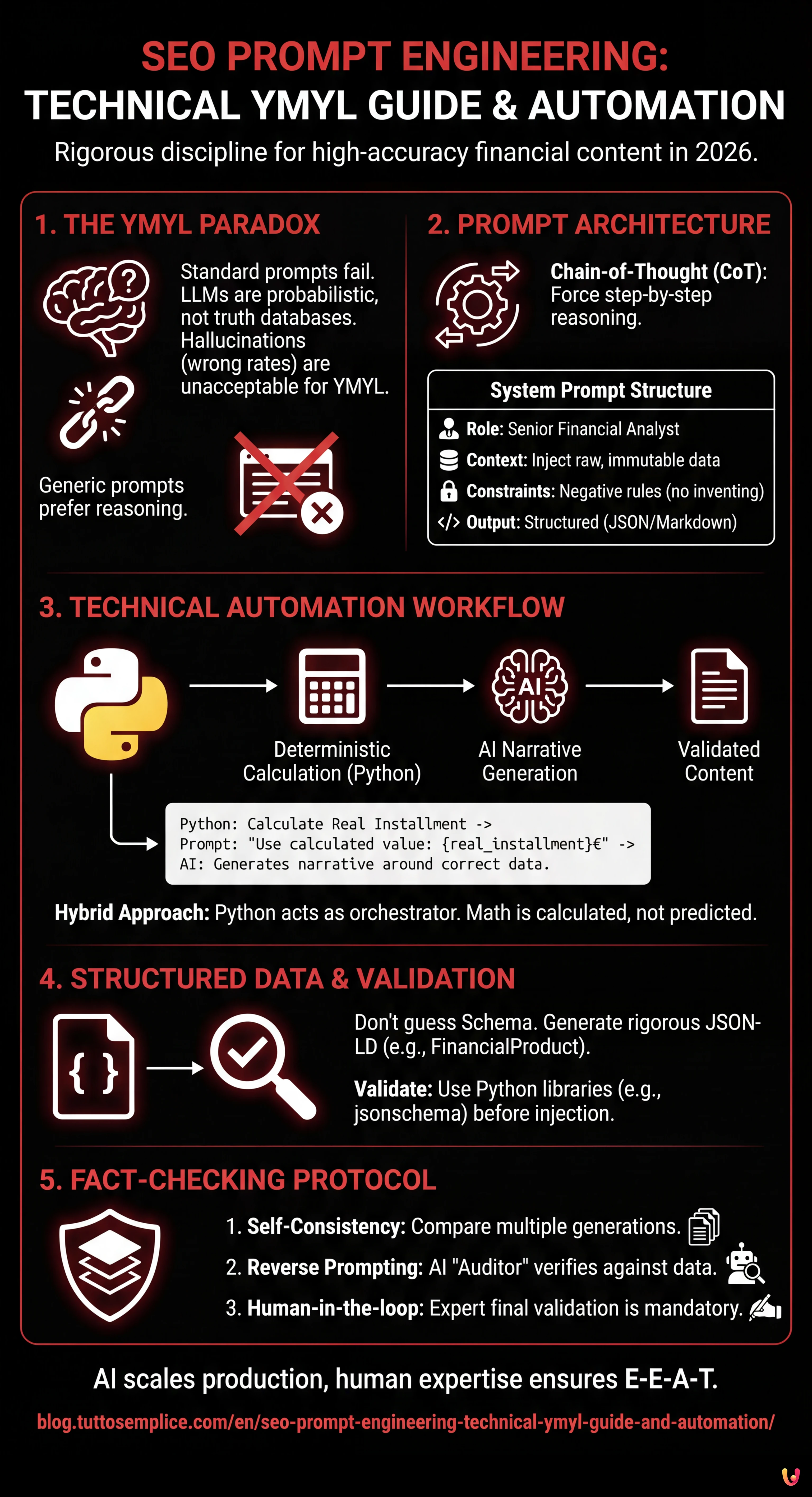
To mitigate errors, we must force the model to “reason” before responding. We will use the Chain-of-Thought (CoT) technique. Instead of asking for the output directly, we instruct the model to outline the logical steps.
System Prompt Structure Example
An effective prompt for financial SEO must be modular. Here is a tested structure for the production environment:
- Role Definition: Define the AI not as a copywriter, but as a “Senior Financial Analyst expert in semantic SEO”.
- Context Injection: Provide raw data (current rates, existing laws) as immutable context.
- Constraints: Negative rules (e.g., “Do not invent rates”, “Do not use promotional language”).
- Output Format: Request for structured output (JSON or specific Markdown).
Technical Workflow: Python and OpenAI API

Let’s move to practice. We will create a Python script that acts as an “orchestrator”. This system does not just generate text but validates numerical data.
Prerequisites
- Python 3.10+
openailibrarypydanticlibrary for data validation
Code: Controlled Generation with Validation
The following snippet shows how to use Function Calling (or Tools) to ensure that financial calculations are performed via code and not statistically predicted by the model.
import openai
from pydantic import BaseModel, Field

# Definition of expected data structure (Schema Validation)
class FinancialContent(BaseModel):
    h1_title: str = Field(..., description="SEO optimized title")
    intro_summary: str = Field(..., description="E-E-A-T compliant summary")
    example_installment_calculation: float = Field(..., description="The installment calculation must be precise")
    technical_explanation: str

# Client Configuration (Pseudo-code)
client = openai.OpenAI(api_key="YOUR_TOKEN")

def generate_finance_article(topic, interest_rate, loan_amount, years):
    # Deterministic calculation (NOT AI) to avoid hallucinations
    # Mortgage formula: M = P * (r / (1 - (1 + r)**-n))
    i = interest_rate / 12 / 100
    n = years * 12
    real_installment = loan_amount * (i / (1 - (1 + i)**-n))

    prompt = f"""
    You are a financial SEO expert. Write a technical section on fixed-rate mortgages.
    MANDATORY REAL DATA:
    - Amount: {loan_amount}€
    - Annual Rate: {interest_rate}%
    - Duration: {years} years
    - Mathematically Calculated Installment: {real_installment:.2f}€

    INSTRUCTIONS:
    1. Use the provided data. DO NOT recalculate the installment, use the value '{real_installment:.2f}'.
    2. Explain how the rate impacts the APR.
    3. Maintain a neutral and institutional tone.
    """

    response = client.chat.completions.create(
        model="gpt-4o",
        messages=[{"role": "system", "content": "You are a financial content validator."},
                  {"role": "user", "content": prompt}]
    )
    return response.choices[0].message.content

# Execution
print(generate_finance_article("Fixed Rate Mortgage", 3.5, 200000, 20))
In this hybrid approach, the engineer calculates the math (Python) and the AI builds the narrative around the correct data. This is the heart of seo prompt engineering for YMYL: removing uncertainty from critical points.
Structured Data Automation (Schema Markup)
To compete in financial SERPs, the FinancialProduct markup is essential. Do not ask the AI to “generate the schema”. Use a prompt that returns a rigorous JSON based on Schema.org specifications.
Example of instruction in the System Prompt:
“Generate ONLY a valid JSON-LD object for ‘FinancialProduct’. Use the interest rate values provided in the context. Do not add text before or after the JSON.”
Subsequently, use a Python library like jsonschema to validate the AI output before injecting it into the page HTML. If validation fails, the script must automatically regenerate the content.
Hallucination Mitigation and Fact-Checking
Even with the best prompts, error is possible. Here is a 3-step verification protocol for YMYL content:
1. Self-Consistency
Ask the model to generate the response three times and compare the results. If numerical data diverges, discard the output and report the error to the human operator.
2. Reverse Prompting (Inverse Verification)
After generating the article, use a second prompt (with a separate AI instance) acting as an “Auditor”.
Auditor Prompt: “Analyze the following text. Extract all interest rates and regulatory claims. Compare them with this reference database [Insert Data]. Report any discrepancy.”
3. Human Supervision (Human-in-the-loop)
Automation prepares the draft to 80-90%. The SEO/Financial expert must always validate the final output. AI serves to scale production, not to replace editorial responsibility.
Conclusions: The Future of Technical SEO
SEO prompt engineering in 2026 is no longer a matter of linguistic “tricks”, but of systemic integration. For YMYL sectors, the key to success lies in the ability to merge the semantic creativity of LLMs with the deterministic rigidity of code. Those who succeed in building pipelines that guarantee data accuracy (E-E-A-T) while automating semantic structure will dominate financial SERPs.
Frequently Asked Questions

SEO prompt engineering for YMYL sectors is a technical discipline that combines the semantic creativity of LLMs with the rigidity of programming code. Unlike standard writing, this method uses logical architectures and data validation to ensure that financial content meets Google’s E-E-A-T criteria, avoiding errors that could penalize rankings or harm users’ financial stability.
To prevent hallucinations in financial texts, it is necessary to adopt a hybrid approach where mathematical calculations are performed by deterministic scripts, such as Python, and not predicted by the language model. Furthermore, using techniques like Chain-of-Thought and three-phase verification protocols, including human supervision and Reverse Prompting, ensures that numerical and regulatory data are correct before publication.
Generic prompts fail in Your Money Your Life sectors because language models are probabilistic engines lacking access to real-time market data and tend to generalize complex advice. Without rigorous context and externally injected data, artificial intelligence risks generating inaccurate information on rates or regulations, violating search engine quality guidelines and leading to content de-indexing.
Python acts as an orchestrator that manages logic and data validation before the AI generates the narrative text. Specifically, it is used to perform precise financial calculations, validate data structure via specific libraries, and automatically generate structured markup like FinancialProduct, ensuring the final output is technically perfect and optimized for rich snippets.
Schema Markup optimization must not be left to the AI’s free interpretation but guided by prompts requiring output in strict JSON format based on official specifications. It is crucial to use validation scripts to check that the generated code respects the correct syntax before injecting it into the HTML, thus ensuring that Google can correctly interpret entities as financial products or services.
Sources and Further Reading




Did you find this article helpful? Is there another topic you'd like to see me cover?
Write it in the comments below! I take inspiration directly from your suggestions.