
In Brief (TL;DR)
ATMs have evolved: not just for withdrawals, but also for deposits, top-ups, and bill payments, for complete management of your banking transactions.
These machines allow you to deposit cash and checks, make top-ups, and pay various types of bills quickly and securely.
Learn how to use ATMs to deposit cash and checks, top up your phone, and pay bills.
The devil is in the details. 👇 Keep reading to discover the critical steps and practical tips to avoid mistakes.
Gone are the days when ATMs were exclusively for cash withdrawals. Today, ATMs (an acronym for Automated Teller Machine) have transformed into true multifunctional service centers, capable of offering a wide range of banking operations with complete autonomy. This evolution responds to a market demand increasingly focused on speed and efficiency, allowing customers to avoid lines at the branch for routine transactions. In Italy, where cash culture is still deeply rooted but digital payments are gaining ground, advanced ATMs act as a bridge between tradition and innovation—a crucial balance in the Mediterranean cultural context.
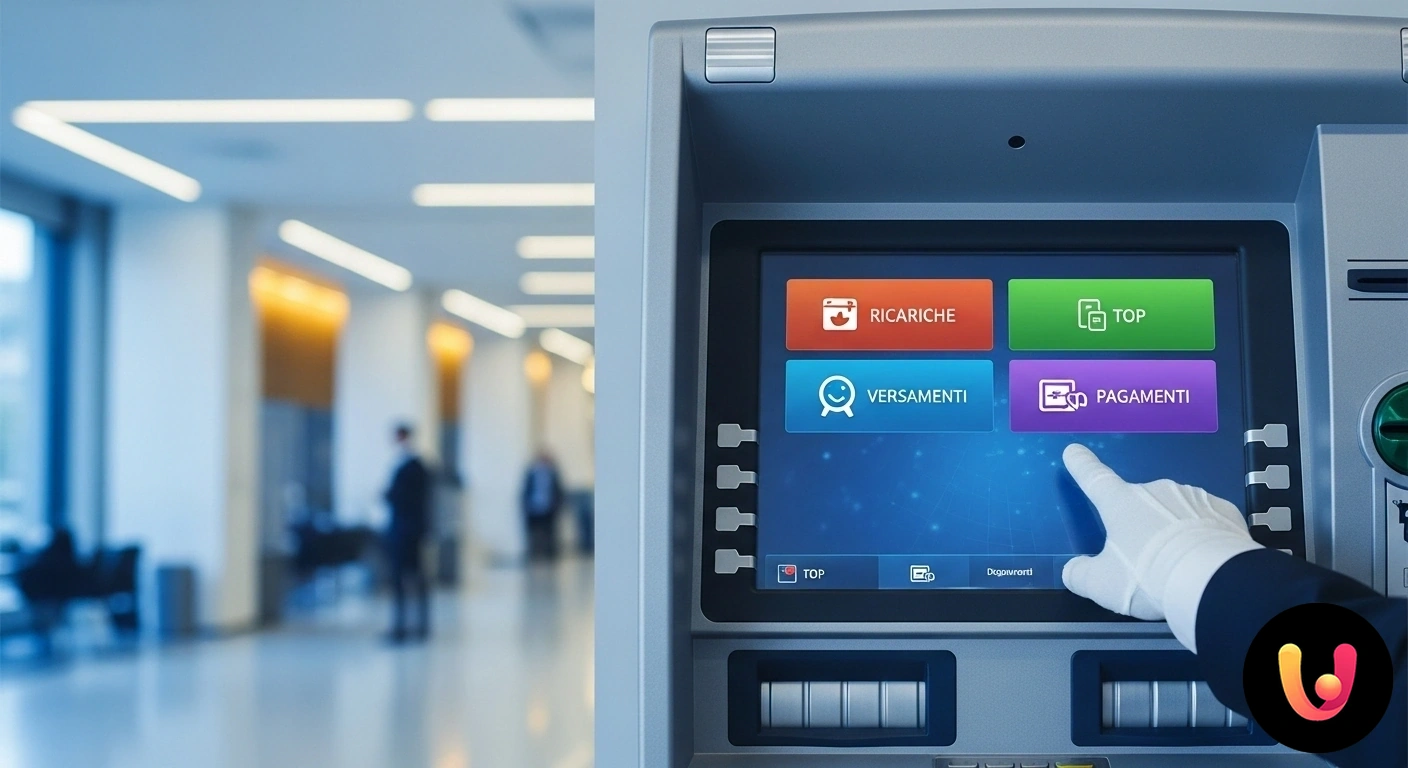
Forget the idea of an ATM as a simple cash dispenser. Modern machines, often equipped with intuitive, multilingual touchscreen interfaces, allow you to make cash and check deposits, pay bills, top up prepaid and phone cards, and much more. This transformation not only simplifies users’ daily lives but also redefines the very role of the bank branch, which can then focus on higher value-added services like financial advising. Technological innovation is leading banks to rethink customer interaction, finding a strategic balance between physical and digital channels in advanced ATMs.
The Evolution of the ATM: From Cash Dispenser to Multifunctional Terminal
The first ATM in history was installed in London in 1967 by Barclays Bank, an invention that revolutionized our relationship with money. In Italy, the first device appeared in 1976, but for decades, its main function remained almost exclusively cash withdrawal. Today, the push toward digitalization and cost optimization has led banks to invest in advanced technologies, transforming ATMs into self-service hubs available 24/7. These new terminals, referred to as “advanced” or “multifunctional,” are designed to go beyond basic operations, integrating features that previously required the assistance of a bank teller.
This transformation is crucial in a context like Italy, which is experiencing a progressive reduction in the number of bank branches, a phenomenon known as a “banking desert.” According to data from the Bank of Italy, the number of traditional ATMs is declining, but at the same time, the availability of new-generation devices is growing, compensating for the closure of physical branches, especially in smaller towns. Poste Italiane, for example, has focused on installing thousands of advanced Postamat ATMs to ensure a widespread presence across the country, offering services ranging from withdrawals to bill payments, confirming the strategic importance of these terminals.
Services “Beyond Withdrawals”: What You Can Do with an ATM Today
Modern ATMs offer a range of transactions designed to cover most daily banking needs. The goal is to provide autonomy, speed, and continuous availability, overcoming the time constraints of bank branches. Advanced services are now standard for most credit institutions, although with some variations depending on the bank and the ATM model.
Cash and Check Deposits
One of the most appreciated innovations is the ability to deposit cash and checks directly at the ATM. The procedure is simple and secure: after inserting your card and entering your PIN, you select the “deposit” option. For cash, simply insert the banknotes (without paper clips or rubber bands) into the appropriate slot; the machine automatically counts them and displays the amount on the screen for confirmation. The credit to the account is often immediate. For checks, the process is similar: the check is scanned, the image is shown on the screen, and after confirmation, a receipt is issued. The credit is usually applied “subject to collection” after the branch’s verification.
Bill and Utility Payments
Saying goodbye to long lines at the counter is also possible for bill payments. Many advanced ATMs are enabled for paying pre-printed postal bills, MAV and RAV payment forms, and major household utilities. Furthermore, integration with the pagoPA system, the national platform for payments to the Public Administration, is increasingly common. To complete the transaction, simply scan the barcode on the bill or manually enter the required data. The payment can be made using your debit card, with a direct debit from your checking account.
Phone and Prepaid Card Top-Ups
Another extremely convenient service is the ability to top up phone credit and prepaid cards. By selecting the appropriate option, you choose the phone carrier or card network, enter the phone number or card details to be topped up, and select the desired amount. The transaction is immediate and allows you to manage your phone credit or prepaid card funds at any time, without having to find an authorized retailer.
Tradition and Innovation: The Italian and European Context
Italy presents an interesting picture where an attachment to tradition, particularly the use of cash, clashes and integrates with rapid digitalization. Despite the growth of digital payments, which in 2024 surpassed cash in transaction value for the first time, a significant portion of the population continues to prefer physical money for daily purchases. In this scenario, the advanced ATM acts as a catalyst, offering a physical service for digital operations. It allows those more attached to cash to easily deposit it into their account and use it for digitalized payments like bills and top-ups, bridging two seemingly distant worlds.
In the broader European market, similar trends are observed but with different adoption speeds. Northern European countries are much further along in the transition to a cashless society, while in the Mediterranean region, the preference for cash remains more pronounced. Advanced ATMs thus become a strategic tool to accompany this transition gradually. The innovation doesn’t stop here: the future of ATMs will see ever-greater integration with artificial intelligence to personalize the user experience and the introduction of technologies like cardless withdrawal via NFC, which further enhances security and convenience.
Security: A Key Factor for User Trust
The increase in features available on ATMs requires ever-greater attention to security. Banks constantly invest in systems to protect users from fraud. New machines are equipped with anti-skimming solutions to prevent card cloning, and ink-staining systems for banknotes in case of a physical attack on the machine. However, security is also the user’s responsibility. It is crucial to follow a few simple rules, such as covering the keypad while entering your PIN, checking for any unusual devices installed on the card slot or keypad, and not being distracted by strangers during transactions.
In case of problems, such as a blocked or cloned card, it is essential to act promptly by blocking the card and contacting your bank. Being informed about possible ATM scams, such as card trapping or skimming, is the first step toward conscious and safe use of these tools. User trust is a pillar for the adoption of any technology, and in the banking sector, this aspect is even more critical.
Conclusion
Advanced ATMs are much more than a simple convenience; they are a key element in the digital transformation of the banking sector, especially in a context like Italy’s that balances tradition with a drive for innovation. By offering services like deposits, payments, and top-ups, these ATMs meet the needs of a diverse user base, ensuring access to essential banking services even in areas affected by the reduction of bank branches. Their ability to integrate operations typical of the physical world with digital logic makes them a strategic tool for guiding all customers, even those less tech-savvy, toward a new way of managing their finances. The future of ATMs is geared toward even greater service personalization and an increasingly secure and intuitive interaction, solidifying their role as a bridge between the physical and digital bank.



Did you find this article helpful? Is there another topic you'd like to see me cover?
Write it in the comments below! I take inspiration directly from your suggestions.