
In Brief (TL;DR)
Adopting a serverless architecture with Next.js and AWS overcomes the limitations of traditional CMS platforms when scaling to millions of pages.
Incremental Static Regeneration optimizes build times by caching popular content statically while generating specific long-tail variations on-demand for immediate availability.
Strategic internal linking and segmented sitemaps are crucial for managing crawl budget and ensuring deep indexing across massive fintech datasets.
The devil is in the details. 👇 Keep reading to discover the critical steps and practical tips to avoid mistakes.
In today’s digital landscape, fintech programmatic seo represents the ultimate frontier for organic acquisition at scale. For mortgage, loan, and insurance comparison portals, the challenge is not just ranking for high-volume keywords like “best mortgage”, but dominating the long tail composed of millions of specific combinations (e.g., “fixed rate mortgage 200k 20 years intesa sanpaolo”).
It is 2026, and the rules of the game have changed: Google demands not only speed but an impeccable user experience and unique content, even when generating millions of URLs. This technical guide explores the architecture required on AWS (Amazon Web Services) to manage a programmatic SEO infrastructure capable of scaling beyond one million pages without sacrificing performance or Crawl Budget.

1. The Scale Problem in Fintech: Why the Traditional Approach Fails
In the Fintech sector, data precision is critical (YMYL – Your Money Your Life). A traditional approach based on monolithic CMSs (like WordPress) collapses under the weight of millions of dynamic records. There are three main problems:
- Unsustainable Build Times: Statically generating (SSG) 1 million pages would take hours, rendering interest rates obsolete before publication.
- Wasted Crawl Budget: Without a surgical internal linking strategy, Googlebot will abandon the crawl before reaching deep pages.
- Thin Content: Pages that differ only by a number (e.g., duration 20 years vs. 21 years) risk being deindexed as duplicates.
The solution lies in a Headless and Serverless architecture, leveraging Next.js for rendering and AWS for global infrastructure.
2. Technical Architecture: Next.js and AWS Amplify
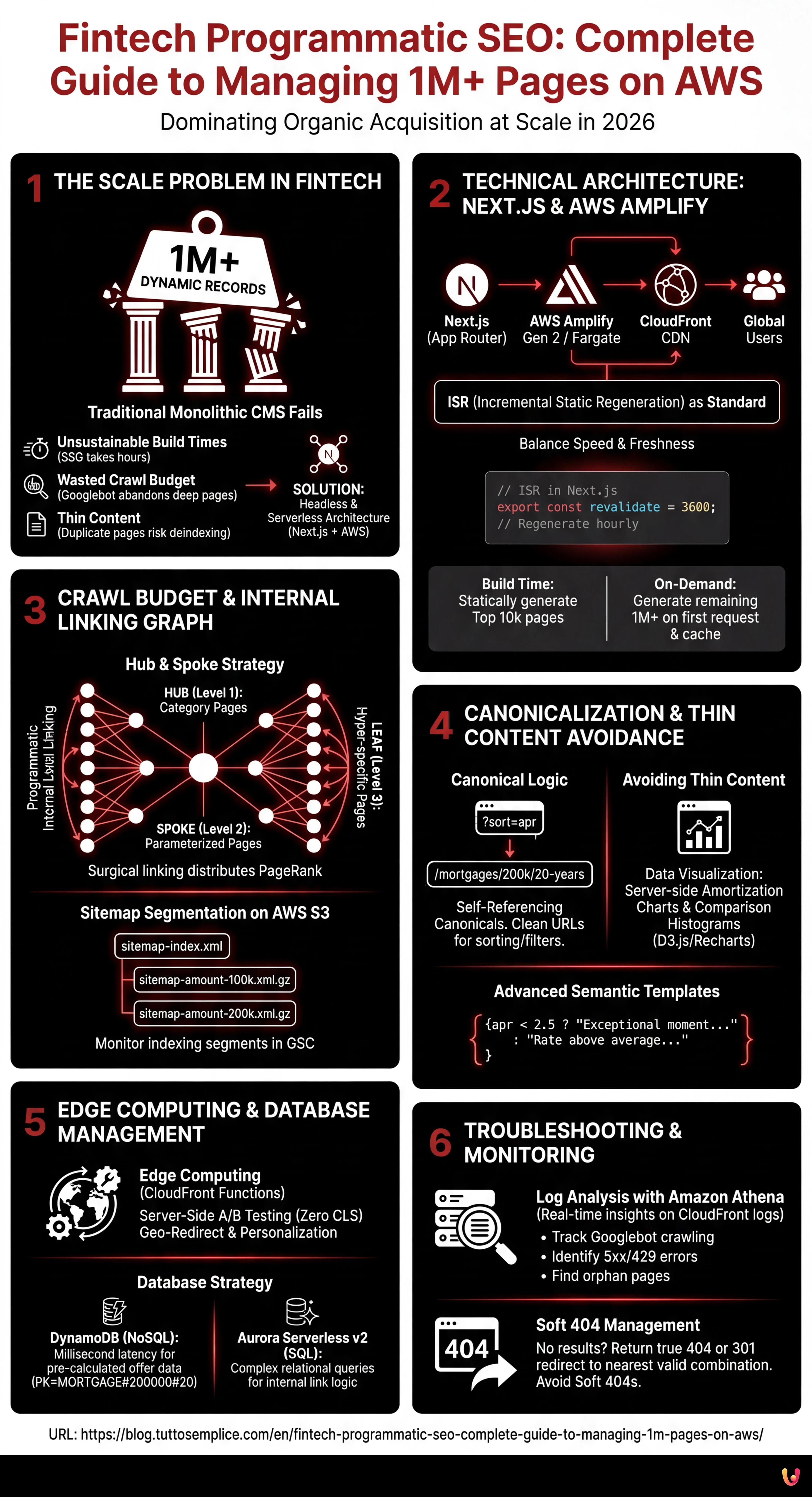
To manage this complexity, the choice of technology stack is fundamental. The winning combination for 2026 involves Next.js (App Router) deployed on AWS Amplify Gen 2 or containerized via AWS Fargate, with a CloudFront CDN in front.
Incremental Static Regeneration (ISR) as Standard
We cannot use pure Server-Side Rendering (SSR) for all pages due to high Time to First Byte (TTFB), nor pure SSG due to build times. The solution is ISR (Incremental Static Regeneration).
With ISR, we can statically generate only the “Top 10,000” pages (those with the most traffic) during the build. The remaining one million pages will be generated on-demand upon the user’s first request and then cached on the CloudFront CDN.
// Conceptual example of ISR configuration in Next.js
export const revalidate = 3600; // Regenerate the page at most every hour

export async function generateStaticParams() {
  // Retrieve only the most popular combinations for the initial build
  const topCombinations = await getTopMortgageCombinations();
  return topCombinations.map((combo) => ({
    amount: combo.amount.toString(),
    duration: combo.duration.toString(),
  }));
}
This strategy reduces build times from hours to minutes, ensuring that less frequented pages still exist and are indexable.
3. Crawl Budget Management and Internal Linking Graph

Having 1 million pages is useless if Google only indexes 50,000 of them. Crawl Budget management is the number one priority in fintech programmatic seo.
The Dynamic “Hub & Spoke” Strategy
We cannot link everything to everything. We must create semantic clusters. Imagine a graph structure:
- Hub (Level 1): Category pages (e.g., “Fixed Rate Mortgages”).
- Spoke (Level 2): Parameterized pages by amount (e.g., “Mortgages 100k”, “Mortgages 200k”).
- Leaf (Level 3): Hyper-specific pages (e.g., “Mortgage 200k for 20 years”).
The secret is Programmatic Internal Linking. On the “Mortgage 200k for 20 years” page, we must not link randomly. We must insert links to:
- The adjacent duration (+/- 5 years): “See installment for 15 years” and “See installment for 25 years”.
- The adjacent amount (+/- 20k): “Calculate installment for 180k”.
- The competing bank with a similar offer.
This creates a natural crawl path for the bot and is useful for the user, distributing PageRank from Hub pages (often externally linked) to Leaf pages (which convert but receive few backlinks).
Sitemap Segmentation
Do not send a single sitemap. On AWS S3, generate segmented and compressed (Gzip) sitemaps:
sitemap-index.xmlsitemap-amount-100k.xml.gzsitemap-amount-200k.xml.gz
This allows monitoring on Google Search Console which segments have specific indexing problems.
4. Canonicalization and Parameter Management
A common mistake is handling filters as URL parameters (?duration=20&amount=200000) without a canonicalization strategy. In programmatic SEO, we want these parameters to become static URLs (/mortgages/200000-euro/20-years).
However, combinations are infinite. It is essential to define a rigorous Canonical Logic:
- Self-Referencing Canonical: Every programmatically generated page must have a canonical pointing to itself, unless it is a nearly identical variant.
- Sorting Management: The URL
/mortgages/200k/20-yearsmight show banks sorted by APR or Installment. The content is the same, the order changes. In this case, the URL with sorting (e.g.,?sort=apr) MUST have the canonical pointing to the clean version of the URL.
5. Avoiding “Thin Content”: Dynamic Injection and Semantic Templates
Google penalizes sites that generate millions of “cookie-cutter” pages. How to make the “Mortgage 150k” page unique compared to “Mortgage 160k”?
Data Visualization as Unique Content
Instead of relying solely on AI-generated text (which can be repetitive), we use data to create unique value. Using libraries like D3.js or Recharts server-side, we can generate:
- Amortization Charts: Unique for that specific amount/duration combination.
- Comparison Histograms: “How does this installment rank against the national average?”.
Google is able to interpret the DOM and recognize that numerical data and SVG/Canvas structures are different, validating the page as unique and useful.
Advanced Semantic Templates
Do not limit yourself to replacing {amount} in the text. Create conditional logic in the template:
{apr < 2.5 ?
  This is an exceptional historical moment to request this amount, with rates below the 3% average. :
  Attention: the rate for this combination is above average. We recommend evaluating a shorter duration.
}
These logical variations make the text truly useful and different for each page cluster.
6. Edge Computing: CloudFront Functions and Lambda@Edge
To keep Core Web Vitals (specifically LCP and CLS) excellent, we must move logic as close to the user as possible. On AWS, we use CloudFront Functions (faster and cheaper than Lambda@Edge) to:
Server-Side A/B Testing
Avoid client-side A/B testing tools that cause flickering and layout shifts. With a CloudFront Function, you can intercept the request, assign a cookie to the user, and serve version A or B of the static page directly from the Edge. This guarantees zero CLS.
Geo-Redirect and Personalization
If the portal operates in multiple countries, use the Edge to detect the CloudFront-Viewer-Country header and redirect the user to the correct subfolder (e.g., /it/ or /es/) before the request even touches the Next.js server.
7. Database Management: DynamoDB vs Aurora Serverless
To power 1 million pages, the database is the bottleneck. In a fintech programmatic seo context, read latency is everything.
- DynamoDB (NoSQL): Ideal for storing pre-calculated offer data. It has millisecond latency and scales infinitely. Structure the Partition Key as
PK=MORTGAGE#200000#20for O(1) access. - Aurora Serverless v2 (SQL): Necessary if you need complex relational queries to generate internal links (e.g., “find all mortgages with APR 15 years”).
A hybrid strategy often works best: use SQL for build/regeneration logic and DynamoDB to serve data to ISR pages at high speed.
8. Troubleshooting and Monitoring
Once live, how do we monitor the health of 1M+ pages?
Log Analysis with Amazon Athena
Do not rely solely on Search Console (which has a delay of days). Configure CloudFront logs to be sent to S3. Use Amazon Athena for SQL queries on logs to discover in real-time:
- Which pages Googlebot is crawling (User-Agent filtering).
- Status codes 5xx (server errors) or 429 (rate limiting).
- Orphan pages receiving traffic but not linked.
Soft 404 Management
If a combination yields no results (e.g., “Mortgage 500 euros for 40 years” – no bank does this), DO NOT return an empty page with status 200 (Soft 404). Implement logic that:
- Returns a true 404 if the combination is impossible.
- Or, better, performs a 301 redirect to the nearest valid combination (e.g., “Mortgage 50,000 euros”), preserving authority.
Conclusions

Implementing a fintech programmatic seo strategy in 2026 requires a paradigm shift: from “content creators” to “data architects”. Using AWS and Next.js allows overcoming the physical limits of traditional CMSs, but the real victory is achieved by curating data quality and user experience.
Remember: the goal is not to trick Google with millions of pages, but to provide the most precise and rapid answer possible to millions of specific user questions. Only those who manage to balance technical scalability and semantic value will dominate the financial SERPs of the coming years.
Frequently Asked Questions

Optimal management requires an internal linking strategy defined as Hub and Spoke, where category pages distribute authority to specific leaf pages. It is fundamental to segment sitemaps on AWS S3 and use programmatic links towards adjacent offers or competitors, avoiding linking everything to everything to guide Googlebot efficiently without wasting scanning resources.
Incremental Static Regeneration, or ISR, solves the problem of unsustainable build times typical of pure static generation on millions of URLs. This technique allows pre-generating only high-traffic pages during the build, creating the remaining ones on-demand upon the visitor’s first request and saving them in the CloudFront cache to guarantee speed and data freshness.
To differentiate similar pages and avoid duplicate content, it is necessary to integrate unique data visualizations such as server-side generated amortization charts. Furthermore, the use of semantic templates with conditional logic allows varying the descriptive text based on specific financial data, offering real value to the reader and making each URL unique in the eyes of search engines.
A hybrid strategy often represents the winning solution for managing large volumes of data. DynamoDB offers millisecond latency ideal for serving pre-calculated data to frontend pages, while Aurora Serverless manages the complex relational queries needed for the internal link building logic, eliminating read bottlenecks.
Moving logic to CloudFront Functions allows executing complex operations like A/B testing and geographic redirects directly on the Edge node, before the request reaches the server. This approach eliminates client-side flickering and reduces Cumulative Layout Shift to zero, significantly improving visual stability and search engine ranking.
Sources and Further Reading




Did you find this article helpful? Is there another topic you'd like to see me cover?
Write it in the comments below! I take inspiration directly from your suggestions.