
In Brief (TL;DR)
Digital marketing evolves into a dynamic engineering system where financial data scientifically regulates ad investment.
Understanding the delay between spend and conversion prevents dangerous cash flow oscillations that threaten company stability and liquidity.
Applying PID algorithms to bidding transforms static rules into mathematical control capable of stabilizing and maximizing ROI.
The devil is in the details. 👇 Keep reading to discover the critical steps and practical tips to avoid mistakes.
In the digital advertising landscape of 2026, the purely creative approach or one based on generic “best practices” is obsolete. To scale a company without compromising liquidity, it is necessary to treat the marketing department not as an artistic cost center, but as a dynamic engineering system. This guide explores the concept of feedback loop marketing through the lens of Systems Theory and Automatic Control, providing a mathematical model for managing budgets and ROI.

1. Marketing as a Dynamic System: Fundamental Definitions
To apply engineering to business, we must first map the company components into a block diagram typical of electronics or automation. In this context, feedback loop marketing does not refer to customer surveys, but to the financial data feedback cycle that regulates advertising investment.
The System Variables
- Input Signal ($u(t)$): The Advertising Budget (Ad Spend) deployed at time $t$.
- Output Signal ($y(t)$): The Revenue generated or the Contribution Margin.
- Process (Plant): The ecosystem composed of the Ad Platform (Google/Meta), Market, Product, and Sales Funnel.
- Disturbances ($d(t)$): Uncontrollable external variables (seasonality, competitor actions, algorithm changes).
- Setpoint ($r(t)$): The desired target (e.g., a target ROAS of 4.0 or a CPA of 20€).
The goal of feedback loop marketing is to minimize the error $e(t)$, which is the difference between our target ($r(t)$) and the actual result ($y(t)$), by manipulating the input ($u(t)$) in real-time.
2. The Transfer Function and Phase Lag
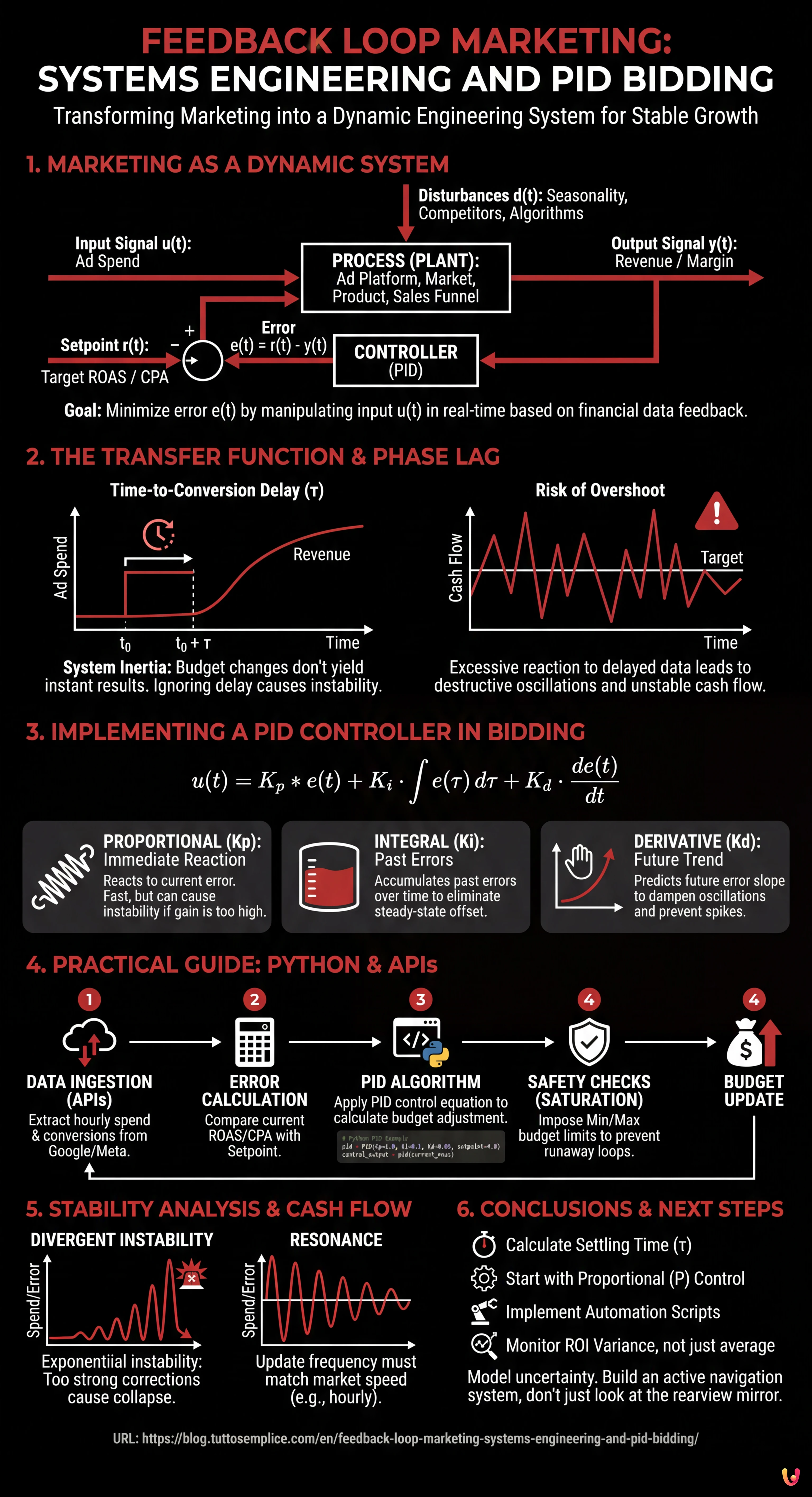
One of the most serious errors in growth hacking is ignoring time. In engineering, every system has inertia. If you increase the budget today (step impulse), revenue does not double instantly.
Time-to-Conversion as Delay ($ au$)
The company system introduces a pure delay (dead time). If the average sales cycle is 14 days, any budget change today will have its full effect in two weeks. Mathematically, this is expressed in the Laplace domain as $e^{-s au}$.
Why is it critical? In a feedback system, excessive delay can transform negative feedback (stabilizing) into positive feedback (unstable). If a media buyer reacts to today’s drop in sales (caused by a budget cut 2 weeks ago) by aggressively increasing spend, they risk creating a destructive oscillation called overshoot. The result is cash flow that fluctuates violently, potentially leading the company to insolvency despite a theoretically positive ROI.
3. Implementing a PID Controller in Bidding

To manage these dynamics, we abandon simple rules (“if CPA > 30, turn off”) and adopt a PID Controller (Proportional-Integral-Derivative). This algorithm, used to pilot drones and industrial thermostats, is the secret weapon for stable algorithmic bidding.
The control equation for the budget $u(t)$ will be:
$$u(t) = K_p e(t) + K_i int_{0}^{t} e(tau) dtau + K_d frac{de(t)}{dt}$$
Proportional Action ($K_p$)
This is the immediate reaction. If ROAS is low, we reduce the bid proportionally to the error. It is fast, but alone it does not eliminate the steady-state error and can cause instability if the gain ($K_p$) is too high.
Integral Action ($K_i$)
The integral looks at the past. It sums errors over time. If the CPA has been slightly above the threshold for a week, the proportional action might not be enough. The integral action “accumulates” this frustration and applies a stronger correction to bring the system back into equilibrium. It is fundamental for eliminating static error in feedback loop marketing.
Derivative Action ($K_d$)
The derivative looks at the future. It analyzes the slope of the error curve. If the CPA is rising rapidly (even if it is still below the target), the derivative action “brakes” the budget increase preventively. This dampens oscillations and prevents dangerous spending spikes.
4. Practical Guide: Building the Loop with Python and APIs
You don’t need million-dollar software; Python and advertising platform APIs are enough. Here is a logical implementation flow:
- Data Ingestion: Use Meta Marketing or Google Ads APIs to extract spend and conversions (or conversion value) every hour.
- Error Calculation: Compare the current ROAS/CPA with the Setpoint.
- PID Algorithm:
# Conceptual example in Python
from simple_pid import PID

# Target ROAS = 4.0
pid = PID(Kp=1.0, Ki=0.1, Kd=0.05, setpoint=4.0)

# Current reading from the system
current_roas = get_realtime_roas()

# Budget multiplier calculation
control_output = pid(current_roas)

# Update via API
new_budget = base_budget + control_output
update_campaign_budget(campaign_id, new_budget)
- Safety Checks (Saturation): In engineering, actuators have physical limits. In marketing, you must impose maximum and minimum limits on the budget (e.g., never more than 1000€/day, never less than 50€/day) to avoid the loop going out of control (integral windup phenomenon).
5. Stability Analysis and Cash Flow
A poorly tuned feedback loop marketing system can lead to two disastrous scenarios:
- Divergent Instability: The system tries to correct an error but reacts too strongly, causing an even larger opposite error, until collapse (budget exhausted in a few hours).
- Resonance: If the budget update frequency coincides with the natural frequency of market fluctuations, oscillations are amplified.
To ensure stability (Nyquist Criterion), it is essential that the sampling and budget update frequency is consistent with the market speed. For most e-commerce businesses, hourly updates are the maximum allowed; minute-by-minute updates only introduce noise into the system.
6. Conclusions and Next Steps
Applying Systems Theory to marketing means stopping driving while only looking at the rearview mirror (monthly reporting). It means building an active navigation system.
Operational steps to start today:
- Calculate your Settling Time: how long does it take for a budget change to stabilize on conversions?
- Start with a simple Proportional (P) control on your main campaigns.
- Implement automation scripts (or use tools that support advanced rules) to close the feedback loop without constant human intervention.
- Monitor not just the ROI, but the ROI variance. A stable system is predictable; an unstable system is expensive.
The future of marketing belongs to those who know how to model uncertainty, not those who try to guess the perfect creative.
Frequently Asked Questions

In the context of systems engineering applied to advertising, Feedback Loop Marketing is an approach that treats the marketing department as a dynamic system. It does not refer to qualitative surveys, but rather to the financial data feedback cycle that regulates advertising investment in real-time to minimize the difference between the set objective, such as the target ROAS, and the actual result obtained.
A PID controller manages the advertising budget through three distinct actions: the Proportional action reacts to the immediate error, the Integral corrects errors accumulated over time by eliminating the static offset, and the Derivative predicts future trends by dampening oscillations. This algorithm allows for abandoning simple reactive rules to adopt a stable algorithmic bidding strategy that optimizes ROI without creating dangerous spending spikes.
Phase lag represents the system inertia between budget deployment and the actual economic return. Ignoring this factor can transform a stabilizing negative feedback into an unstable positive feedback, causing violent oscillations in cash flow known as overshoot; therefore, it is fundamental to calculate one’s own settling time before aggressively modifying bids in response to recent performance drops.
To build an automated bidding system, it is sufficient to use Python scripts connected to the APIs of advertising platforms like Google or Meta. The process involves hourly extraction of spend and conversion data, calculating the error relative to the desired setpoint, and applying the PID algorithm to update the budget, being careful to insert minimum and maximum saturation limits to prevent the system from going out of control.
A poorly calibrated feedback system can lead to divergent instability scenarios, where the budget is exhausted rapidly due to excessive corrections, or to resonance phenomena that amplify natural market fluctuations. To avoid these financial risks, it is essential to monitor ROI variance and ensure that the budget update frequency respects the temporal dynamics of the business, avoiding overly frequent changes that only introduce noise.
Sources and Further Reading




Did you find this article helpful? Is there another topic you'd like to see me cover?
Write it in the comments below! I take inspiration directly from your suggestions.